

“The most intellectual thirst trap ever made”
In this edition of the Weekender: arthouse lust, the economics of ketchup, and the secret language of galleries


This week, we’re gooning in the Criterion Closet, counting SKUs at Costco, and designing the ideal art exhibition.

CULTURE
“The most intellectual thirst trap ever made”
Lyvie Scott on the strange sex appeal of the Criterion Closet.

A love letter to the Criterion Closet, the most intellectual thirst trap ever made
— Lyvie Scott in LOVR GIRL
In the quote replies of the latest video posted by Twitter user @Criterion—which features Mad Men star Jon Hamm thoughtfully waxing poetic about rare independent films—you’ll find some of the most hellish thirst tweeting this side of the Pittdom. Sprinkled between comments on the quality of his choices (favorable) or the odd Mad Men reference are solicitations that range from the evergreen “can I say something” to the far more opaque “now pull your d*ck out.”
I thought this was a classy party, I briefly, bemusedly thought aloud on my inaugural scroll. Then I scrolled a little farther and came across the tweet that proved otherwise: “we’re not supposed to call this goon bait??”
Yeah. The Criterion Closet is goon bait now. Or maybe it always has been?
It is, for the record, absolutely insane that something as austere and tame as the Criterion Closet has become so synonymous with abject goonery. It was the Letterboxd Four Favorites before Letterboxd was a thing you heard namedropped in prestige TV shows; a genius brand of marketing in its own right, if not a little nicher. Criterion has been preserving hard-to-find films—from international auteurs to old Hollywood restorations and, recently, acclaimed streaming originals—for over 30 years now. They house their film inventory in a closet at their headquarters in New York, and for the past 15 years they’ve invited filmmakers or standup comedians or podcasters into said closet to pilfer ultra 4K Blu-rays and box sets in the guise of promoting their latest project. I can’t stress how brilliant this marketing is, truly, even if there’s no way it’s all that profitable and it’s known exclusively to a certain brand of chronically online movie nerd. Two Americas, and all that. But for that America, the Criterion Closet is essentially Hot Ones. And I do mean that in every way that matters.
I kid you not—you can find thirst tweets attached to nearly every Criterion Closet vid. Every man over the age of 35 who steps into this hallowed crawl space can get it. Jason Bateman slutted it up in a plain black tee, as did Oscar Isaac, whose own trip to the closet coincided rather serendipitously with the writing of this dispatch. He also cleaned that thing out with a level of greed I’ve not witnessed since Barry Jenkins’ closet visit. The Cut famously named Ben Affleck the “most charming guy in the Criterion Closet,” which I’m not positive I agree with but hey, it’s all subjective. There’s a “hit the towers” energy in the way Nick Offerman’s visit absolutely shattered my TL. Diego Calva even flashed us in the closet! The slut!
Men on the geriatric side of the Hottie Spectrum get plenty of love, too: there’s something about those soft fluorescent lights, the compulsion to speak passionately and articulately about film, that just makes everyone in the Criterion Closet automatically really hot. John Slattery got some polite “still would”s in reaction to his visit. Tracy Letts strolled in, confidently said, “I already have all these movies,” and was rewarded with a handful of suggestive gifs. I found myself doing a little mental “hear me out” watching Guillermo del Toro’s mobile closet picks. Other crushes I already had, like Alden Ehrenreich, got even hotter—like, infinitely hotter? Deliriously hotter?—upon visiting Criterion. Even Bob Odenkirk, whose trip to the closet dropped in tandem with Hamm’s, got a bit of love in the QRTs. Maybe Bob Odenkirk has always had lusters, but I certainly never would have known that had it not been for Criterion.
Now I’m sure you’re asking, “but what about the women?” Or alternatively, “what about the Black people?” Great questions—and here is where that aforementioned “nearly” comes into play.
Never have I been so abruptly reminded of Criterion’s target audience as I have been while poring through their closet videos. What Criterion does for older men, for crushes you might be a little bit ashamed to reveal out loud, is a modern phenomenon. It does not do the same for anyone who isn’t old and a man (or white and/or eligible for Latin Lover status). Charli XCX was in there; I can’t say it really moved the needle. Zoë Kravitz and Channing Tatum did the rare couples Criterion vid just weeks before calling off their engagement—the equivalent of giving a dog (me!) chocolate before putting it down—but their joint slay barely registered on the bisexual Richter scale. Lucy Liu reminded us all of her status as the baddest b*tch alive and was rewarded only with a smattering of sincere “she’s so cool”s. Same for Nia DaCosta. Same for Margaret Qualley, who apparently is someone that people kind of objectify? In an arthouse-y way?

VIDEO
Southern grace
A short film exploring family memory through the landscapes of the rural South.
In the Garden
— Ivey Redding in everything I can remember

COMMERCE
The cost of choice
Justin Kuiper on how Costco’s unique business model gives it a competitive edge.
Why Costco pays $30/hr and Target doesn’t
— Kuiper in Kuiper's blog
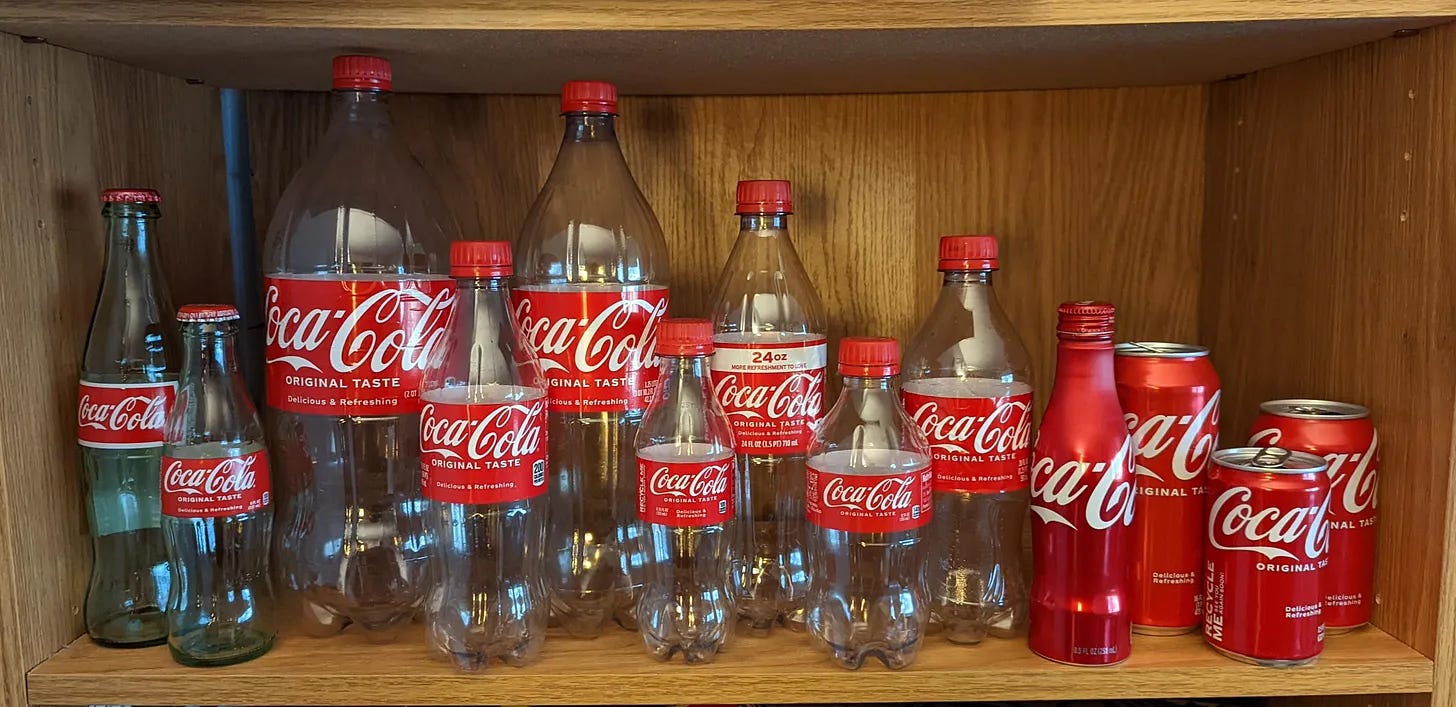
Walk into a Walmart and you’ll find over half a dozen ways to buy regular Coca-Cola: you can buy 12 oz cans, 16 oz bottles, 20 oz bottles, and 2-liter bottles. The cans come in 12-packs and 24-packs, and that’s before we’ve touched Diet Coke or Coke Zero.
Each of those is what retailers call a “stock-keeping unit” (SKU), each of which has to be treated by the inventory system as a distinct product.
An average Target carries around 80,000 SKUs, while a typical Costco carries only 4,000 SKUs, a 95% smaller catalog despite Costco’s retail locations being physically larger than Target’s by around 18%. Costco has more items in their warehouse but less variety. They just identify the most popular SKUs and sell more of them.
Target tries to have “a little something for everyone,” and that imposes costs on the business. If a SKU is obscure or unpopular enough, it might never get bought, winding up as “dead inventory.”
When you have 10 varieties of ketchup, maybe you never manage to find a buyer for the last two bottles of the least-popular kind. Even if it does eventually sell, it might sit on the shelf for a long time before someone buys it.
Costco avoids this problem by selling fewer kinds of ketchup (and fewer varieties of everything else, too). There are fewer “unpopular items” that spend time languishing on the shelf.
This “fewer SKUs” approach has many other benefits for Costco:
Costco’s “No Touch Policy”
Fewer SKUs means lower operational and labor costs.
Much of Target’s labor cost is paying employees to stock shelves. Look at this photo of a Target employee physically bending over to place an item on the shelf:

I can report from my experience as a young Target employee that this process is as laborious and inefficient as it looks. Note the brown corrugated cardboard boxes next to the employee: those are the boxes that the product came in. After he’s done shelving the product, he will need to flatten the cardboard and dispose of it.
Costco’s more efficient restocking method has a name: the “no touch” policy, where products are placed directly on the sales floor without being unpacked. You’ve probably seen this before: an employee drives a forklift out to the sales floor, drops off a pallet, maybe takes an empty pallet back with them, and heads back without ever disembarking from their forklift.
There’s no Costco employee who has to “arrange the merchandise on the shelf” to make it look nice, because there aren’t shelves within reach of the customer.
Why can’t Target use this same high-efficiency method? They have more SKUs.
Because Target has “a little something for everyone,” most Target SKUs don’t occupy a whole pallet, which is why you might need to have an employee make a trip to stock 6 more bottles of Habanero Ketchup.
But having fewer SKUs is also great for financial reasons, too:
Faster inventory turnover means fewer costs
Because Costco only stocks popular SKUs, their inventory moves faster. (Think about what is implied when we say a product is “flying off the shelves”: it’s literally spending less time sitting on the shelf!)
Shelf time is costly: the retailer has to pay rent, utilities, security, and all the other overhead that comes with maintaining the physical space a product occupies. A product that sits on the shelf for 15 days before being sold is far more costly than an item that gets bought within 2 days of hitting the shelf.
Target, with 20 times as many SKUs, carries far more slow-moving inventory that lingers for weeks before anyone buys it.

POETRY


MIXED MEDIA
Art by Rachel Bevan Baker



CURATION
How to hang a Warhol
Alya, an exhibition designer, breaks down the invisible architecture of a museum show.
The Anatomy of an Exhibition
— Alya in Object Labels
Art Placement
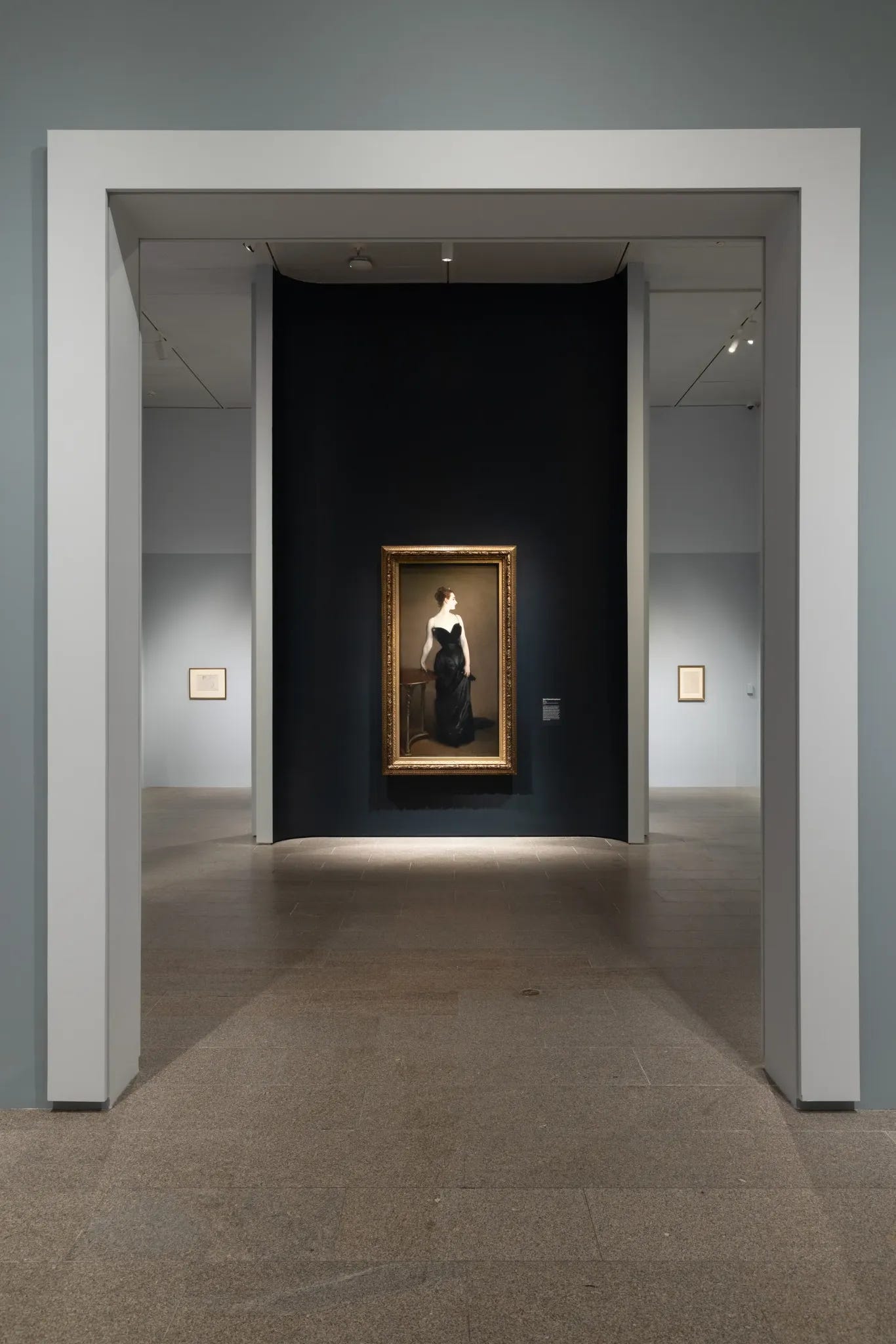
Let’s start with the obvious: the art itself, and where it goes. This is the curator’s domain.
Curators shape the overall vision, meaning, and experience of a show. The selection and placement of works tells the story they want to tell, signaling relationships, relevance, and narrative within a collection of work. Art placement happens early, in close collaboration with the living artist and exhibition designer (hey, that’s me!), right at the very start of the planning process.
Curators either are, or become, deep experts in the work being shown. Hearing them talk through an exhibition is breathtaking. Curators speak about art like old friends, with intimacy, precision, and affection. I have to actively stop myself from gawking every time.
Floor Plan & Traffic Flow
The floor plan is a collaboration between the curator, living artist, and the exhibition designer, and it typically happens in tandem with art placement in the early design of a show.Circulation, sight lines, and the highlighting of key objects are all mission-critical conversations. You want visitors to move through a show naturally and intuitively. You want them to be comfortable, curious, and never confused or claustrophobic. Nobody wants to feel crammed while contemplating a Picasso or feel lost in a hallway when there’s a Rothko around the corner.
The Art Handlers
Yes, there is an entire profession of art handling. And no, I cannot do it. When I first started working at a museum, a few friends excitedly asked this. Lolz, absolutely not—the liability alone!
Art handlers have a highly specialized skill set. They wear gloves, unpack pieces with extraordinary tenderness, are fluent in reading art manuals (yes, some individual works come with entire manuals dedicated to their installation), and install each work with a precision and care that is genuinely beautiful to watch.
Wall Color
I’d be willing to bet you can’t tell me the wall color of the last exhibition you visited. And I’d also bet that your experience would have been substantially different if it had been painted another shade.
The era of the all-white modernist cube is fading (for the most part!). Wall color is a powerful tool in setting the atmosphere of a show. It’s subtle but transformative. Think of it like a wine pairing: the color is chosen to complement the work on display. Wall colors can also function as wayfinding, guiding visitors through different areas without a single sign.
Wall color decisions involve the curators, the artist (if living), the exhibition designers, and sometimes the graphic designers. Every curator and exhibition designer I know has a favorite color to use in a show (mine is purple, because I am, unabashedly, a regal girly). I’ve also heard a rumor that the Met does not like to use green paint, but you did not hear that from me!

MALAPROPS IN MEMORIAM

Substackers featured in this edition
Art & Photography: Frederic Forest , Rachel Bevan Baker
Video & Audio: Ivey Redding
Writing: Lyvie Scott, Kuiper, Tubi, Alya, Jonathan Malesic

Recently launched

Dr Amy Boyington, the Cambridge-trained historian, author, and broadcaster, has launched a Substack. Her work finds the dark, human stories hiding inside history’s most iconic images—in a recent post on the girl at the center of Velázquez’s Las Meninas, she writes that “that beautiful dress was a uniform, that palace was a gilded prison.”
Inspired by the writers and creators featured in the Weekender? Starting your own Substack is just a few clicks away:

The Weekender is a weekly roundup of writing, ideas, art, audio, and video from the world of Substack. Posts are recommended by staff and readers, and curated and edited by Substack’s editorial team.
Really like the SKU stories from Target and Costco and definitely want to dig deeper into them. Fewer SKUs is often strategically good because focus matters more than breadth. However, maybe it is just my personal feeling, but no matter what, you still eventually end up going to places like Walmart or Target to grab the specific items you need and you spend more money than you planned.
You had me at “intellectual thirst trap.”
🤓