

You wouldn’t be here for someone else
B.D. McClay on Taylor Swift, fame, and the allure of a showgirl

Editor’s note: Taylor Swift’s The Life of a Showgirl has dominated charts, airwaves, and social feeds alike—including Substack’s. We asked essayist and critic BDM to make sense of the album and Swift’s singular ability to drive the discourse.
With her newest album, The Life of a Showgirl, Taylor Swift has the number one song, the number one album, and the number one movie in America. She’s the first artist to achieve this feat; not even Prince’s Purple Rain reached these heights. She’s set to blow past Adele’s first-week sales record of 3 and a half million albums. Swift’s fame and commercial success might make this seem like no big deal—sure, we could all sell 3 million albums if we were that famous—but that gets the causality backward. She only hits marks like these because she treats every release like success has to be earned all over again. As a longtime fan, I often roll my eyes at the stunts she pulls to make sure her fans buy the album: the multiple variants, the exclusive tracks, the carefully timed announcements. But I also buy the album, and so, apparently, do a lot of other people.
No current pop figure is as in control of their career as Swift is—directing her own music videos, owning her masters, dictating when and how she releases music. That kind of control is only possible because she’s reached a rare level of fame that shapes the conversation, whether people want to participate in it or not. For instance: you’re reading this post, even if you’re grumbling to yourself about how tired you are of hearing about Taylor Swift. You wouldn’t be here for someone else. It’s no fun to be exasperated at somebody else.
Swift’s been singing about her difficult relationship with fame since “The Lucky One” on Red (2012), a track that asks, Wouldn’t it be nice to throw all this over and just be a girl with her guitar? She followed up Red with the smash hit album 1989, which implicitly answered this question with: nah. A concept album about being a showgirl should be a perfect fit for her themes. Every text about show business is also a text about fame and contains the following message: show business is the worst thing in the world, and it’s the only thing worth doing. Show business involves precarity on a level that goes beyond the financial—show to show, crowd to crowd, you stake everything every time and put the fate of your performance in the hands of people who may be barely paying attention. (One edition of Showgirl is titled “The Crowd Is Your King.”)
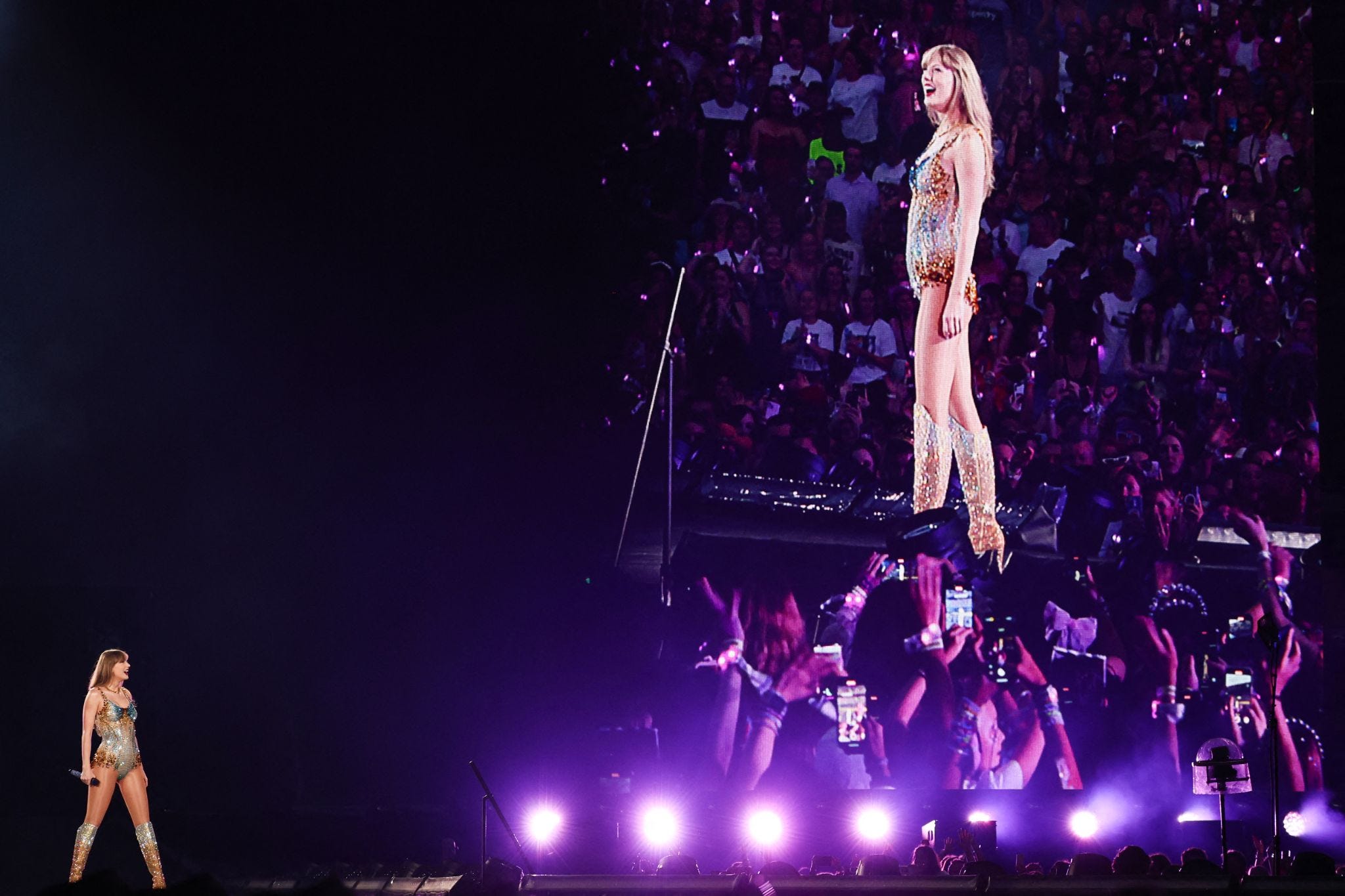
Swift clearly loves being famous, and she also, just as clearly, hates being famous. Anyone who’s seen Taylor Swift on a stage can see how she pulls strength from the crowd; anyone can also see the downsides of living her life (stalkers, surveillance, the dissolution of private life). She performed her Eras Tour routines sick, with a chunk of her hand missing, and through a heel breaking off her shoe—the kind of dedication that’s neither love nor compulsion, but both. That double-edged devotion to the stage should be the beating heart of an album about the life of a showgirl.
But for all of its pleasures, Showgirl only flirts with that theme. So let’s cut to the chase: it’s a fun album, just not a great one. It feels more like a little treat to keep the fans tided over while Swift prepares to spend a few years focused on her personal life—a digestif after the heavy meal of the Eras Tour and The Tortured Poets Department—than it does a full artistic project on its own.
The love songs are sweet—“Opalite,” with its invocation of false and true loves and its girl-group flourishes, is about to rule every wedding dance floor for the next five years. “Wood,” where Swift runs through every dick joke you can think of (and a few you definitely couldn’t) is cheekily and euphorically sexual. The vengeful songs are unapologetically acid, and all the better for it. In the past, Swift’s had a tendency to work the refs if she wanted to settle a score, but now she just settles the scores herself. In Lover’s “The Man,” Swift complained that if she were a man, people would like her more; now, in “Father Figure,” she takes on a mob-boss persona and sends an enemy to sleep with the fishes. Who cares about being liked, anyway? Not Vito Corleone. In Old Hollywood, they sometimes called women like Swift—ultra-feminine artists with a keen eye for business and a long memory for wrongs—steel butterflies. They’re my favorites, and all of this adds up to a good time.
But what is this album about, really? It was supposed to be about the offstage part of the showgirl life, but there’s little of that to be found. There’s the title track—a duet with Sabrina Carpenter—an ode to showgirl life and the fickleness of the crowd. “Elizabeth Taylor,” the album’s second track and its best, is the only other song that directly discusses fame and the effect it has on Swift’s life. It’s framed as a conversation with Elizabeth Taylor’s invisible presence, as Swift sings that whether or not any love lasts forever for her, it certainly lasts forever in the minds of others.
“Elizabeth Taylor” is a wonderful song, with one of the album’s cleverest lines (“I’d cry my eyes violet,” as in, she’d cry so much her blue eyes would become so bloodshot, they’d be purple, thus resembling Elizabeth Taylor’s—it’s better how she says it). But two songs isn’t much, and that brings us to the album’s other flaw. As the Eras Tour demonstrated, Taylor Swift has many selves, and many artistic sides. There’s Taylor the storyteller, with her country roots; there’s Taylor the pop monster. The first Taylor gave us lines like “You made a rebel of a careless man’s careful daughter,” lines that contained a whole world through her use of careful detail. The second Taylor knows how to write a song you want to turn up on the radio—but these hits have often come at the sacrifice of detail. One of the promises of Showgirl was that it would unite these halves.
So, does it? Some songs, yes; some songs, no. The aforementioned “Opalite,” for instance, opens, “I had a bad habit of missing lovers past / my brother used to call it, ‘Eating out of the trash’”—this is a classic detail. But “Honey,” a song about how her new lover has taken all the terms that used to feel passive-aggressive and made them feel real, is the kind of song that should feel rooted in detail. That a word could be transformed when said by the right person is the kind of experience Swift specializes in bringing to life. But the people who poisoned words like “sweetheart” are generic mean girls and bad guys; the new guy who says it and means it also doesn’t feel real. It’s a nice song, and it has some of Swift’s most heartfelt vocals on Showgirl, but it could have been a better one.
On the other hand, some of her lyrics on this album are cringe in a way that is ultimately one of Swift’s virtues. Swift’s gift as a lyricist, aside from her storytelling, is her ability to take objects in our verbal culture—Ophelia, TikTok memes, stock turns of speech—and combine them and turn them inside out. Perhaps even more than she loves music, Taylor Swift loves language. She loves double meanings, flipped meanings, puns; she loves language in all its sonic dimensions. She’ll willfully mix a metaphor, because she knows the jarring contrast between images can create something more memorable than a perfect line. There’s a lot of crude imagery on Showgirl, and there’s been a lot of tittering about it, but many of these moments are serving a purpose. “I can make deals with the devil because my dick’s bigger,” from “Father Figure,” wields its blunt language over George Michael interpolation and an otherwise sophisticated self-presentation. These lyrics look bad written out—but that’s fine. Lyrics are supposed to go with music, not stand alone.
Much like Swift’s Lover, a very uneven album with some of Swift’s best songs (“Cruel Summer,” “Cornelia Street”) and her worst (“London Boy,” “You Need to Calm Down”), The Life of a Showgirl is an uneven album, but this time without career highs or career lows. Like Midnights, it has a strong opening half with a weaker back end. Taken together, what this trilogy of good-but-flawed pop albums suggests—at least to this writer—is that there’s not much left for Taylor Swift in the world of pure pop music. She has sucked that marrow dry. In the “anthology” edition of The Tortured Poets Department, she’s also explored what was left in the sonic world of folklore. What I’m saying is that whenever she comes back with album 13, Taylor Swift needs to pick up an electric guitar. It’s time.
As it is, The Life of a Showgirl is a victory lap. This is what it looks like to win in just about every way a human being can. Swift knows as well as anybody else that what goes up must come down, but when you’re up, you’re up. Might as well have fun. After all—how many of you clicked on this to read an album review? That’s not what anybody wants to read. They want a review of Swift, the person. They’re getting that review on every social media platform in the world right now. Here it is: A lot of people hate Swift. They are tired of seeing her face. They are tired of hearing her voice. They comb through the album for signs that Swift is not only a bad artist but a bad person. Stacked against the measurable response to the album—the sales and the streams—their hatred doesn’t really signify, which only intensifies matters. One line is that Swift is only so popular because she’s so mediocre that she gives her equally mediocre fans something to aspire to. But at the risk of sounding cute, there are a lot of mediocre people, and there’s only one Taylor Swift. Magic Eight Ball says: Try again.
Fame is fickle, but Taylor Swift has proven uniquely adept at riding its waves. If she’s treading water with this album, and she is, onlookers would be very foolish to think she’s sinking. Everyone should have learned this lesson years ago—Taylor Swift, up or down, is never over. Did I say get ready to hear “Opalite” at every wedding for the next five years? Make it 10.

 | A guest post by
|