

“You can’t transform the world unless you can understand it, and you can’t understand the world unless you can measure it”
In this edition of The Weekender: grappling with potential, scamming a scammer, and AI's actual impact

This week, we’re cherishing Jimothy, translating The Odyssey, and getting advice from 10-year-olds.
SELF-DISCOVERY
Great expectations
Emily North explores the experience of “having potential,” and the weight that comes with ambition.
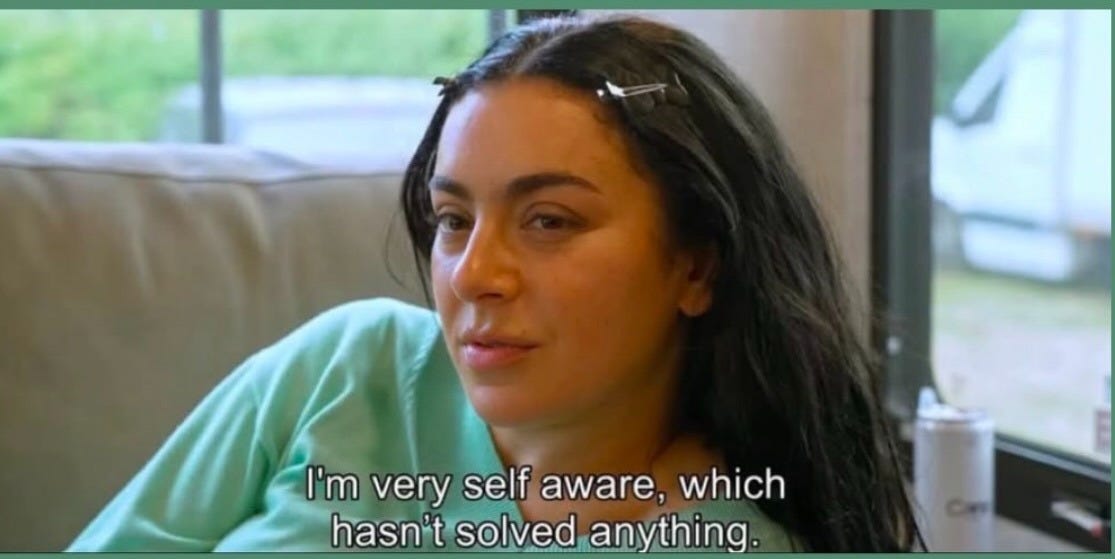
now what am i going to do with all this potential?
i do not have a fear of aging, but instead i have a fear of time passing and me not opening my mouth wide enough to catch everything. some of you may know one of my favorite quotes is, “kiss the joy as it flies” but lately i don’t just want to kiss it, i want to stick my tongue so far down its throat before it has to leave. i have dedicated this summer to being the one where i do literally whatever i want at all times. as a rule this is how i like to live my life 365 days a year but this summer in particular i have been practicing joie de vivre as if it was a prayer and i am on my knees begging for nothing about my life to change i promise to be good i promise i will be fun and sexy and kind forever i promise i promise i promise i will do anything thank you God amen.
walking around with the weight of your potential has a special kind of power to make you notice the pace at which days, weeks, years fly by in your calendar. i spent the past week with my extended family where my tiny cousins have somehow morphed from toddlers into little teenagers who are able to do k-pop choreography with precision, i overheard my little brother taking work calls from the dining room using a low voice i have never heard before, my sister was talking about when she wants to have a baby, and i realized my parents have had the beach house for almost ten years. lately time has been moving as slow as honey, except for when it slides down my throat it burns instead of feeling sweet. i feel i am wasting my time by lying in the sun and reading books and drinking too many martinis and staying out way too late on a weeknight… i could be using this time to become a better daughter, sister, colleague, friend, future partner and instead i am lying in a pool of my own sweat, physically and emotionally drowning in myself. my anxiety about the slipping of time is extremely self-indulgent, so much so that even typing this essay has made me lose my appetite. to be so obsessed with the pace of your own life and its potential blinds you from the people you pass along the way. happiness fuels self-obsession, despair fuels self-obsession, all i want to do is feel numb and forget who i am and never face anyone who thinks about my potential ever again.
at my best, when i chug along the rosy pink path i make for myself i know that my potential is not finite, it has no expiration date, and i am a girl of exceptional tenacity to make her life exactly how she wants; however, i would be lying if i said i didn’t crack from time to time and think about when it will all eventually leave me.
PERSPECTIVE
HUMANITIES
“I hate to be that guy, but the book is a lot better than the film”
Emily Wilson, a classical scholar who has translated both The Odyssey and The Iliad, shares her thoughts on Christopher Nolan’s adaptation in an excerpted Q&A.
If you can bear to hear the truth you’ve spoken/twisted by knaves to make a trap for fools...
—EMILY WILSON in EMILY’s Substack
You’ve dedicated much of your career to bringing the Odyssey to life. What are your initial reactions to the film?
I very much hope many people go and see it in cinemas—it’s worth it to see it on the big screen, because so much of the movie is about the visual effects, as well as the very loud soundtrack. This film is an event, and it has a lot of memorable moments. But I hope those who do so will also read or reread the poem. I hate to be that guy, but the book is a lot better than the film.
You’re the first woman to have her translation of the Odyssey published in English. What does that mean to you, and why does it matter?
Mostly, I don’t think it matters at all. It’s a silly little factoid, not something particularly relevant for my actual work. Gender wasn’t a topic in my scholarly or critical work before I began work on the Odyssey. I’d published various books and articles, mostly about male authors and male characters, with very little attention to gender. I’d published earlier translations—of Seneca’s tragedies—and none of the reviewers or readers of those translations seem to have thought my gender mattered for that work, and nor did I. But all of a sudden, “Woman Translates Odyssey” became the universal headline, and then journalists began to ask me endlessly and unstoppably about my supposedly female or feminine or feminist perspective. Whatever I say or do, it continues even unto this day.
I’ve found it quite limiting to have my work constantly framed by journalists in terms of my gender. I see it as both simplistic and anti-feminist to insist that all women’s work has to be viewed as primarily “women’s”, as if all our toys must be pink and no other color—whereas men, lucky things, get to focus on what they actually care about, which might not be gender at all. Everything a woman does has to be described as a “feminist intervention”, even if she doesn’t see it in those terms at all (which I certainly don’t). As members of the unmarked gender category, men get to imagine that their gender has nothing to do with their interpretations or perspectives on the world or on literature or history. I keep urging journalists to ask men about their gender and how it informs their work, and please stop asking me about it, because I really don’t work on gender and it’s not my main interest... but those pleas don’t seem to be going anywhere.
I took on the project of re-translating the Odyssey, and then the Iliad, for reasons that had nothing to do with my gender identity, but had to do with my specific scholarly training and literary sensibilities, as someone with longstanding interests in poetic and narrative form, the long traditions of both ancient and early modern verse, and a very long-standing interest in drama and dramatic narrative. I felt that there was an opportunity to provide English readers with translations in traditional, regular meter—in contrast with the dozens of existing free verse and prose translations—and versions that would, like the originals, have a supple multiplicity of voice and perspective, as well as their emotional directness and vividness. Those proto-dramatic qualities are flattened in many existing translations. In approaching any dialogue or scene in the Homeric poems, I make a conscious attempt to understand how the text portrays multiple perspectives, and I don’t assume ahead of time that women characters will be presented as inferior or ridiculous. But that’s surely not feminism; it’s about being a reasonably responsible, competent translator of these great poems. The bar for what “feminist translation” means ought to be a lot higher than that.
Beyond my own specific work: the fact that most translations of ancient texts into English have been done by men is notable and quite surprising. There are plenty of English-speaking classicists of all genders, so it’s not about lack of people who could do it, in theory. Plenty of women scholars have written books and articles about Homer. In other linguistic traditions (like French and Italian), there are plenty of published translations of ancient texts, including the Homeric poems, by women. I think it may have to do with the different educational traditions, and differing attitudes towards translation in general: in France and Italy, more people of all genders have some knowledge of ancient Greek and Latin (because of the lycée/ liceo schools), so there’s a wider pool of people qualified to translate texts like the Odyssey—it’s not confined to those who have PhDs—and within the Anglophone academy, translation has traditionally been treated as a marginal pursuit—and therefore, the translation of ancient texts is often done by those who aren’t working towards tenure. But I still don’t fully know how to explain the gender gap. Maybe it’s partly about networks: I personally would have never done any of my translations if I hadn’t been invited to do so by specific editors in publishing houses. It seems possible that English-speaking publishers and editors have more often reached out to men, when looking for someone to sign up to create a new translation of a big epic poem. Beyond that, I really don’t know how to explain it.
TROUBLESHOOTING
TECH
Will AI actually upend life as we know it?
For the past few years, artificial intelligence has been touted as an earth-shattering advancement for humanity. Noah Smith argues that, while this new technology has reshaped our habits in many ways, it has yet to shatter our current reality.
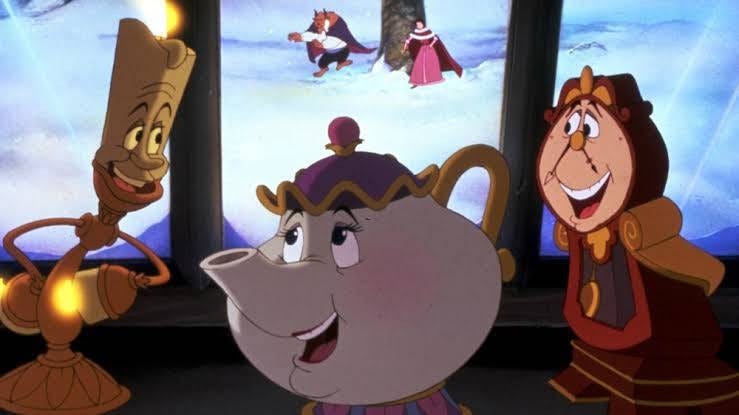
What will more intelligence actually do for us?
—Noah Smith in Noahpinion
Not a lot of people expected that AI would come for the mathematicians before it came for the truck drivers, but it did. The other day, an AI model disproved the Jacobian Conjecture—an 87-year-old open problem that human mathematicians had struggled to solve. The greatest living human mathematician, Terence Tao, turned to AI to help him understand the solution. Around the same time, AI solved a very important open question in quantum cryptography. Solving Erdos problems has now become almost child’s play for the best AI models. And this is the worst AI will ever be at math. Model capabilities, and the amount of compute available, both continue to increase at rapid rates. (Meanwhile, long-distance trucking employment is slightly higher than it was a decade ago.)
I don’t expect mathematicians to actually lose their jobs en masse, of course. But it’s becoming clearer and clearer that humankind has invented machines that are smarter than we are. Intelligence isn’t defined for machines the same way it is for humans—AI’s capabilities are spiky in different ways than ours—but it’s undeniable that the technology is improving rapidly in every domain of cognitive capability. It’s still possible to find some mental tasks that humans are better than machines at, but those final advantages tend to disappear almost as quickly as we can identify them. “AGI”, or “ASI”, or whatever you want to call it, is certainly here.
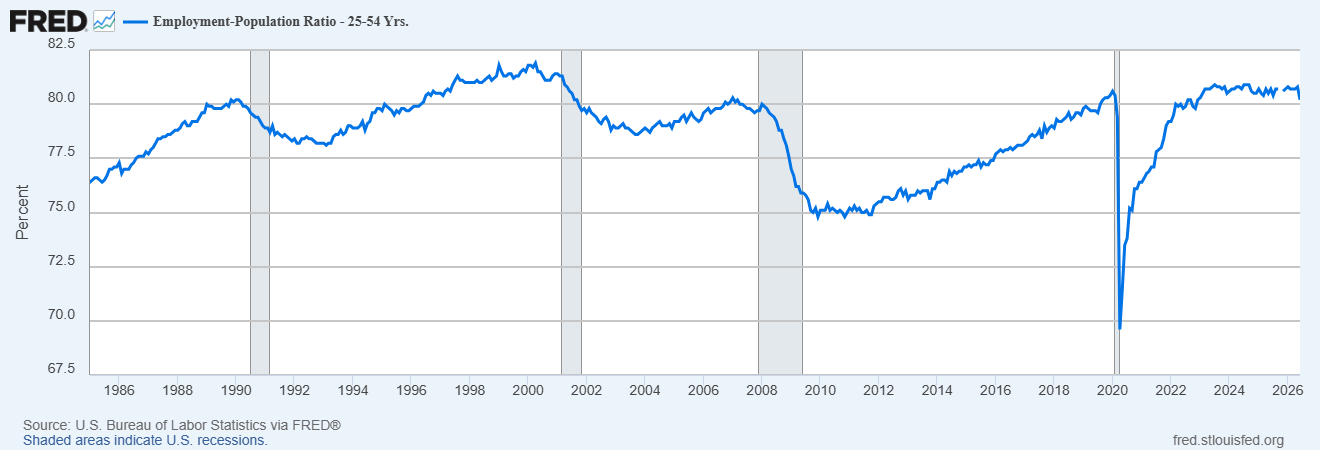
And yet… the world remains much the same. In lots of sci-fi books, as soon as artificial superintelligence arrives, it bootstraps itself to even more godlike intelligence in an explosive “singularity” that rapidly transforms the entire physical universe. Lots of people, especially “AI safety” and “effective altruist” types, expected things to play out basically the same way in reality. But looking around, not much has changed since we entered the intelligence explosion. There’s a huge data center boom, and most people use AI on a daily basis, but we still live basically the same lives—driving to work or taking the train, sitting in front of a computer, scrolling on our phones, collecting a paycheck. People are staying in their jobs longer, but employment hasn’t been disrupted in a significant way:
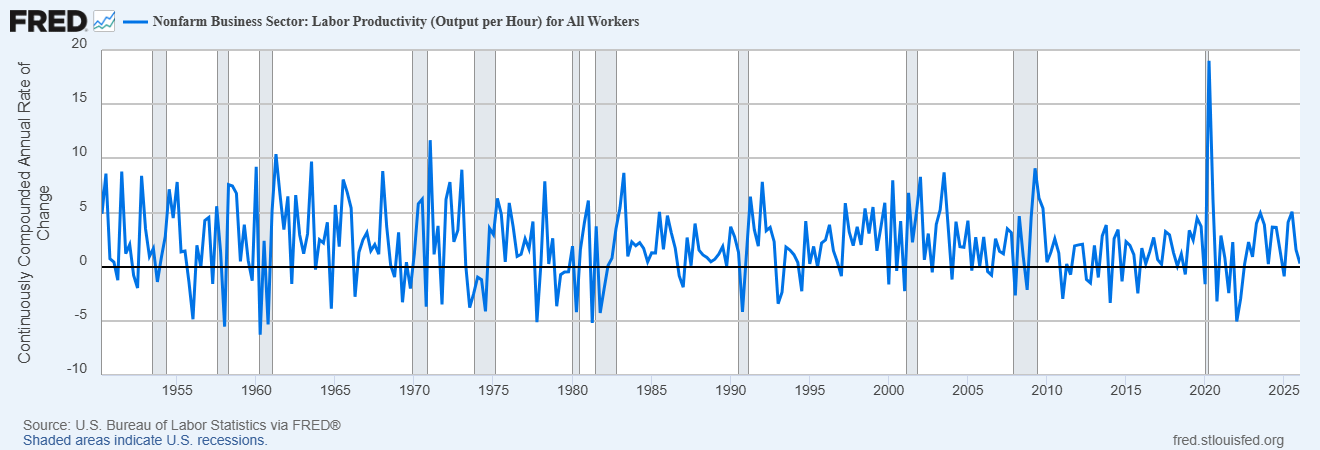
Meanwhile, we’ve had decently robust productivity growth, but nothing really amazing:
[. . .]
It seems possible that humans are simply incredibly specialized in a few types of cognitive tasks—extracting patterns from sparse data, synthesizing various patterns into “intuition” and “judgement”, and communicating those patterns in language—and that we’ve basically approached the theoretical maximum in those narrow areas… That would explain why AI has gotten much better at things like math and coding and forecasting over the last year but why the basic chatbot interface doesn’t seem much more “intelligent.” It would also explain why when you talk to Terence Tao about math, it’s like talking to a superhuman, but when you talk to him about where to get lunch or which movies are the best, he’ll just sound like a fairly smart normal dude. AI will eventually get better than Tao at math… but it may never get much better than the most thoughtful, eloquent humans at deciding where to get lunch or recommending movies. It may simply not be mathematically possible to get much better than we already are at that sort of thing.
Why would intelligence top out like this? Well, if we think of intelligence as the ability to extract information from data, then even an infinitely advanced model endowed with infinite compute will be limited by the fact that there’s a limited amount of information that can be extracted from the data.
For one thing, data itself is in limited supply. You can’t transform the world unless you can (in some generalized sense) understand it, and you can’t understand the world unless you can measure it, and our ability to measure the world is inherently limited and finite.

ICONOGRAPHY

PAYBACK
Feud of the fraudsters
A legion of ne’er-do-wells is targeting an already-vulnerable group (contemporary writers). Bess Kalb took matters into her own hands.
How to torment a scammer
—Bess Kalb in The Grudge Report
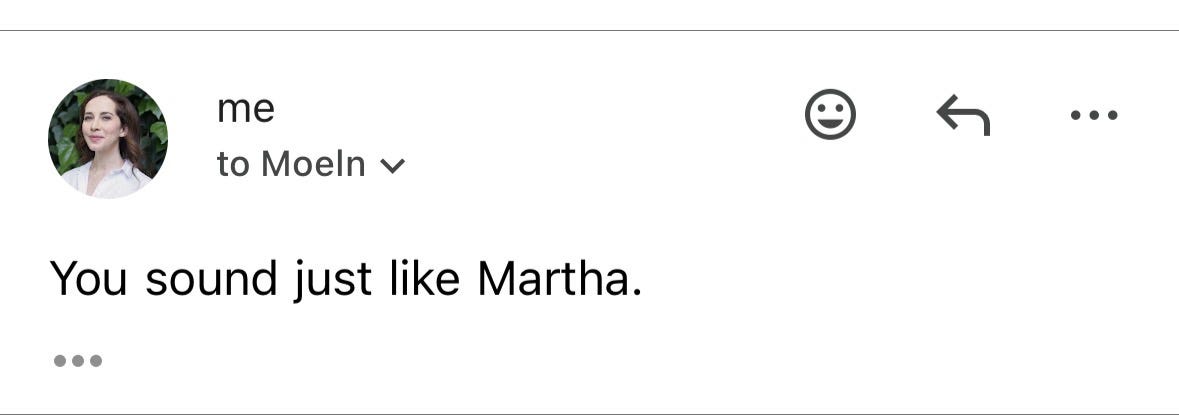
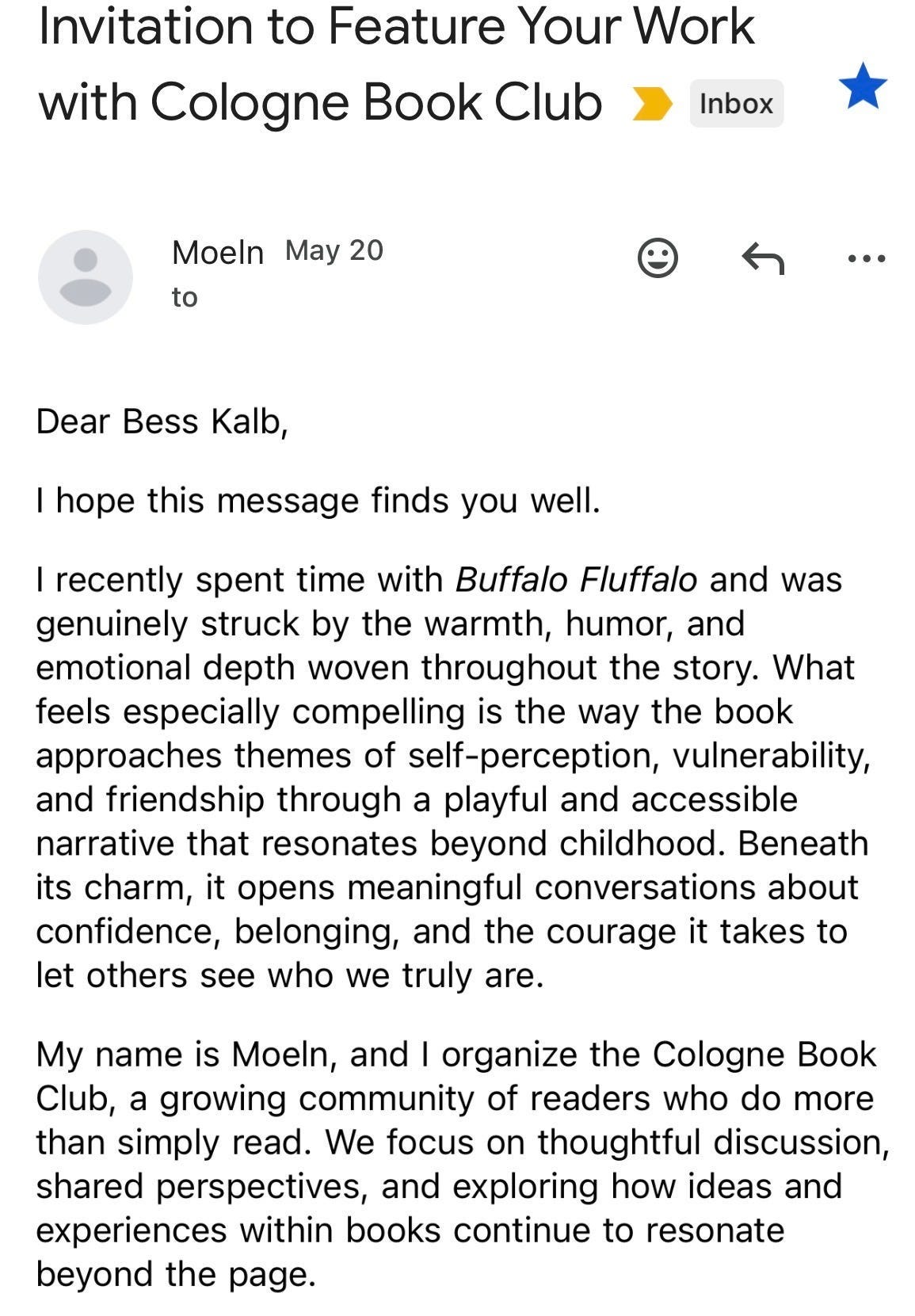
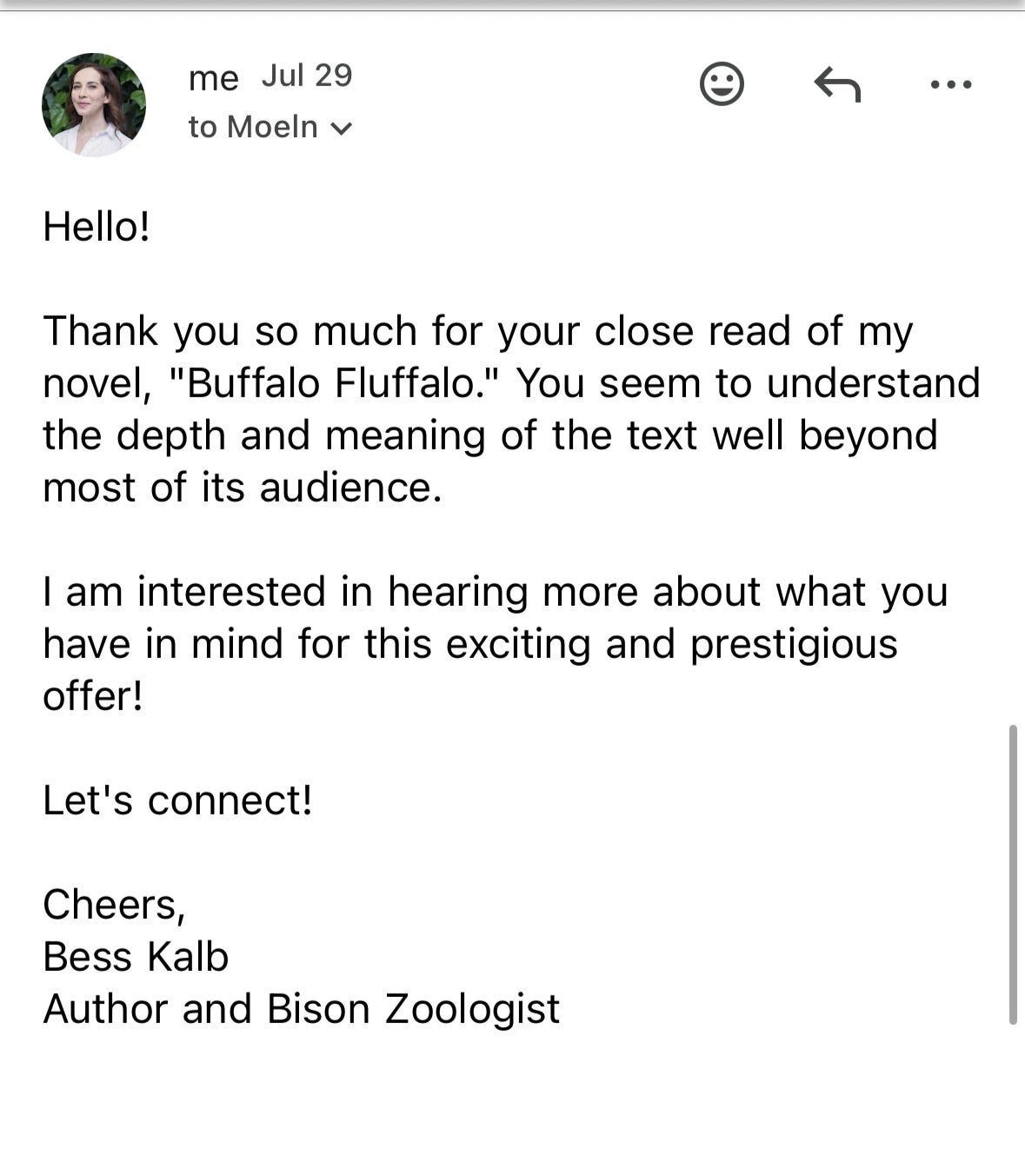
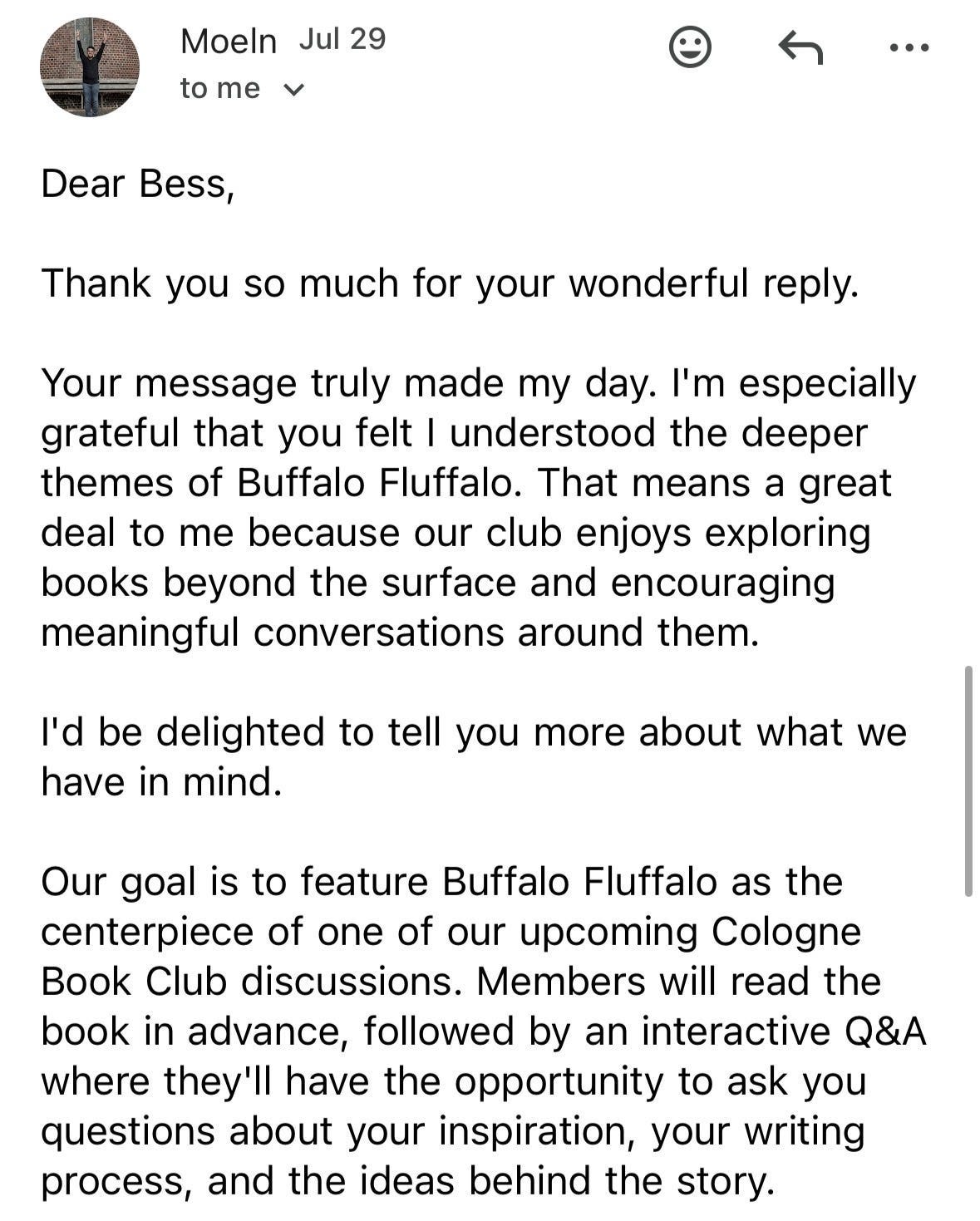
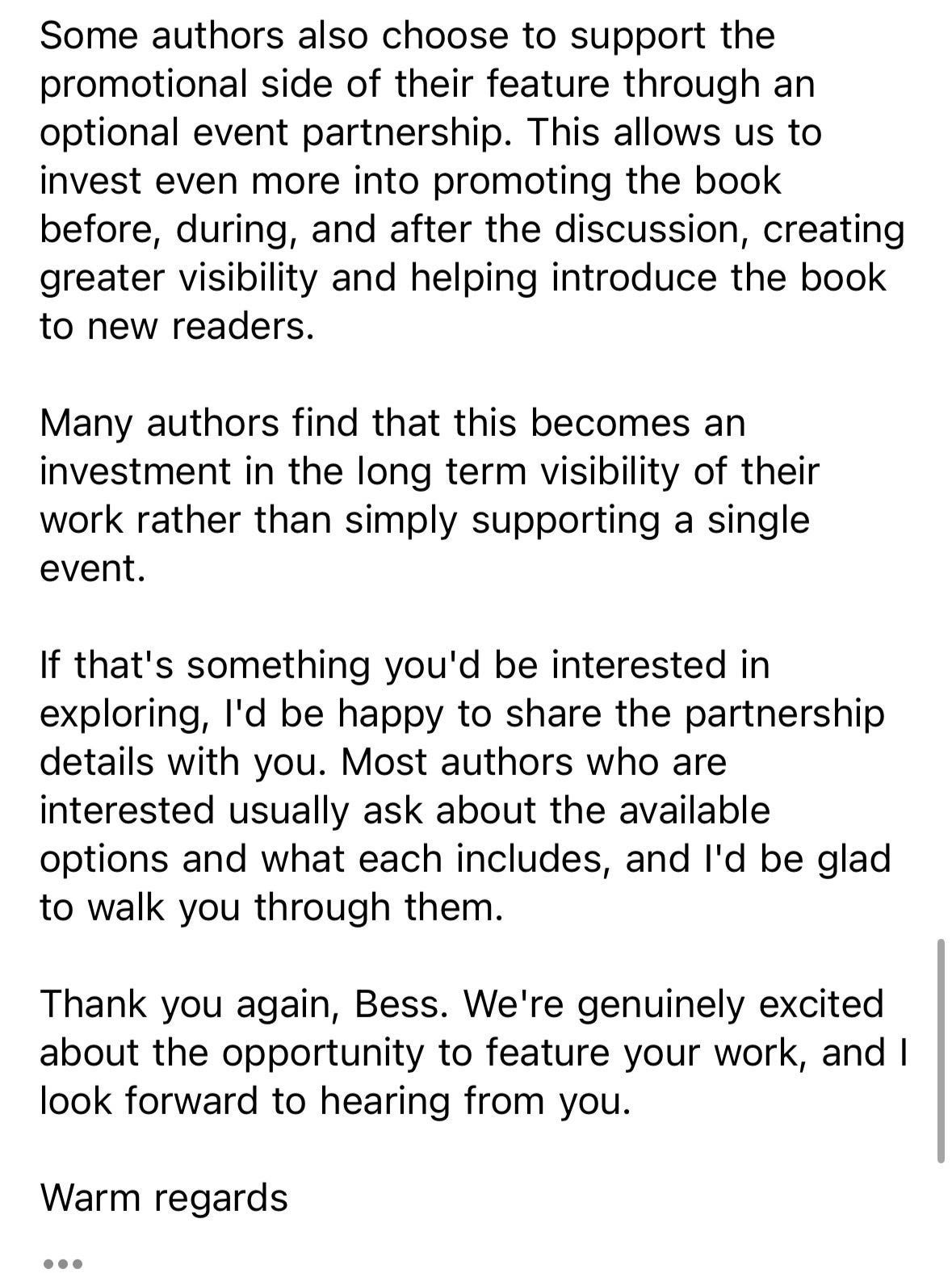
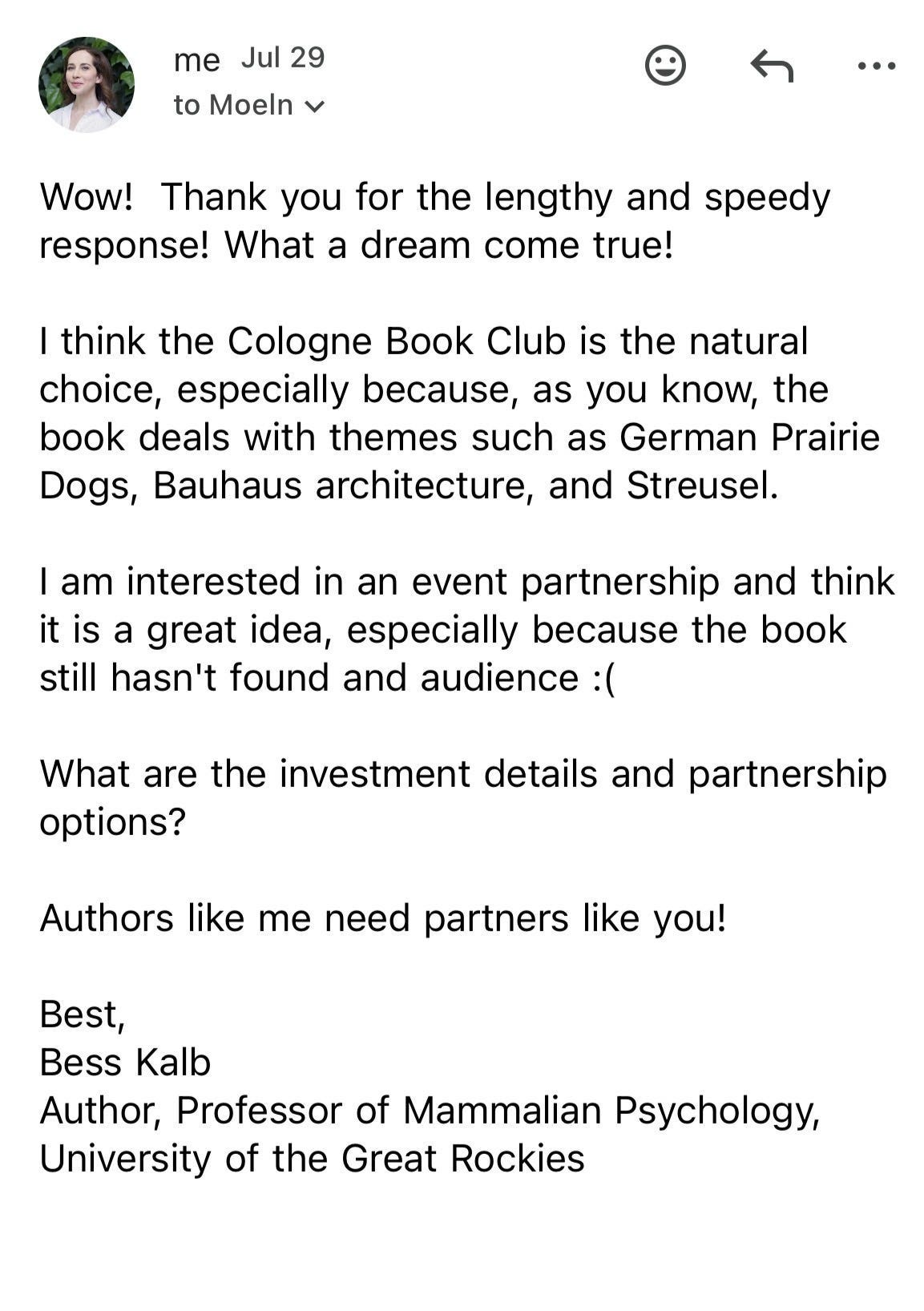
There is a predatory vanity scam targeting authors, in which the scammer writes an email lavishing an author’s work with effusive, specific praise, then invites the author to take part in a book club event, then charges the author to promote the event. The “book clubs” all have European-sounding names, and lack a website or any online footprint, and the emails are glaringly AI-generated. The proliferation of these scammers makes me sad because it means authors struggling to find a readership are falling for them. And PAYING them. It is a vulturous, pathetic, dystopian nightmare that weaponizes AI against the declining publishing industry by making an author feel seen and celebrated, only to siphon hundreds and thousands of dollars from them. Normally, that’s what publicists are for.
To torment one scammer right back, I decided to go completely insane. Here is the record of that saga, for your amusement and mine.
FREE WILL
PARENTING
When the student becomes the teacher
A child’s worldview is shaped by their caregiver. Turns out the inverse is true too.
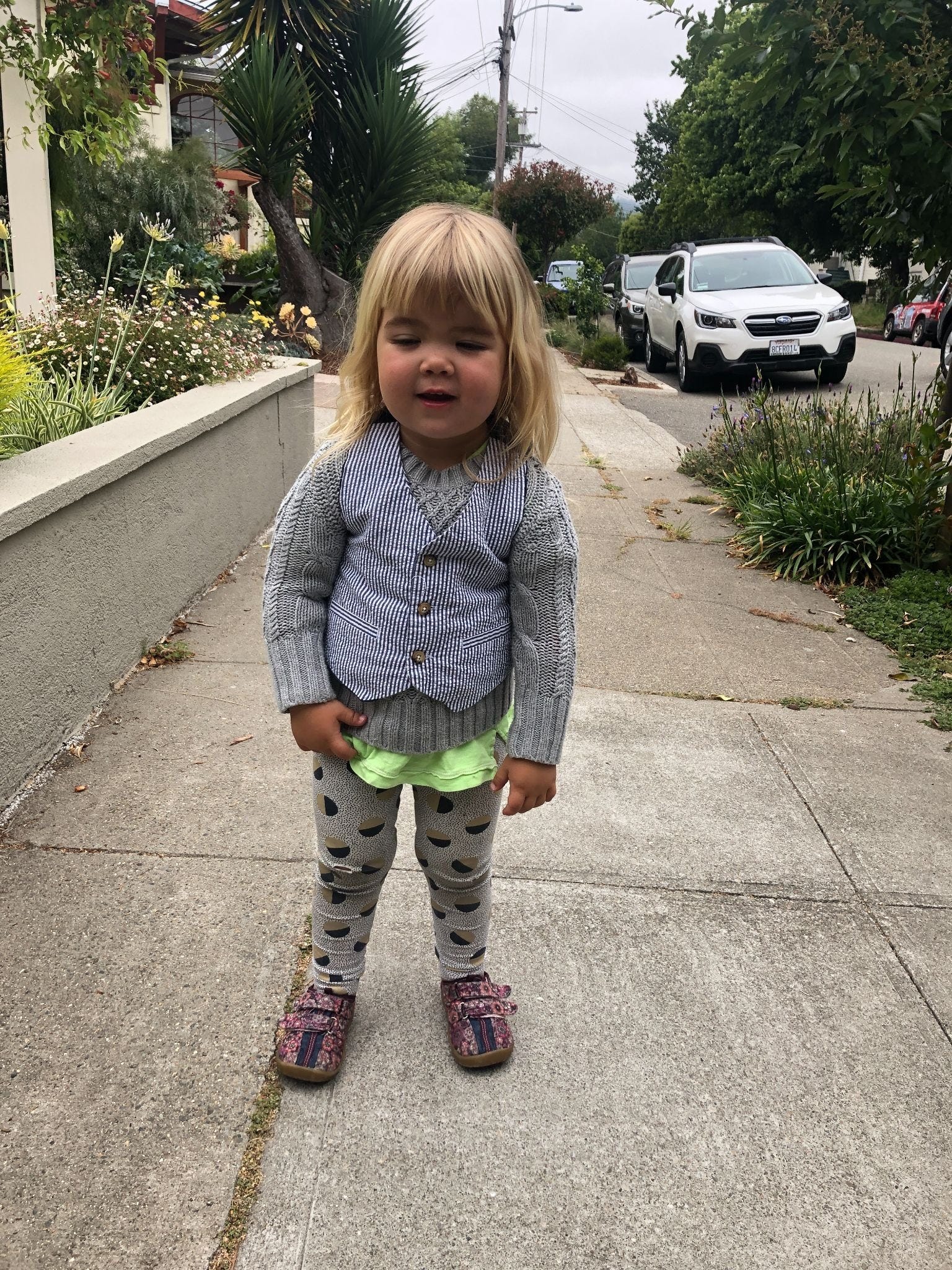
Ten things my kid has taught me
—Courtney Martin in the examined family
Stella turns 10 years old tomorrow. A decade of Stella is a lot of Stella, and of course, I can’t wait for as many more as life will bless me with. She’s unlike anyone I’ve ever met, with some star trails of various family members (dead and alive). She’s a real Leo—confident in her talent, magnanimous and charismatic, and very emotional. Thanks for making me wiser, my girl…
Completion is for suckers. The measure of how worthwhile something is should not be whether you finished it. In fact, who says what’s finished? We don’t even know if death is a real ending. Why would we keep doing something once it stops being fun and alive for us?
Fluidity is where it’s at. If you worry less about defining yourself or other people, you have more time to respond in the white hot moment to what you feel, what you want to wear, and who you want to crush on. Stella hasn’t read Octavia Butler yet, but damn if she doesn’t live like “the only lasting truth is change.”
Feel your feelings and move them along. Stella loves feelings. She has a feelings posters taped on her wall, a wheel of emotions in her room, and notebooks filled with original love songs, dreams, and secrets. When she gets mad, you really know it. When she’s sad, it permeates the room. And then it’s gone—moved on through her body because it had a chance to be exercised, expressed, acknowledged.
Apologize genuinely and quickly. Stella can be hurtful, but she also registers when she’s hurt someone and is very quick to apologize—usually in a handwritten note slipped under the door. She doesn’t seem to be hampered by a grand theory that she doesn’t or won’t hurt people, like some of us; she knows she will and she’s explicitly sorry when she does.
ACCIDENTAL ART
Substackers featured in this edition
Art & Photography: ida, Jess Focht, Kristin Merrilees, Zoe Si, abby rothwell, Gina
Writing: emily north, EMILY WILSON, Noah Smith, Bess Kalb, Courtney Martin

Recently launched
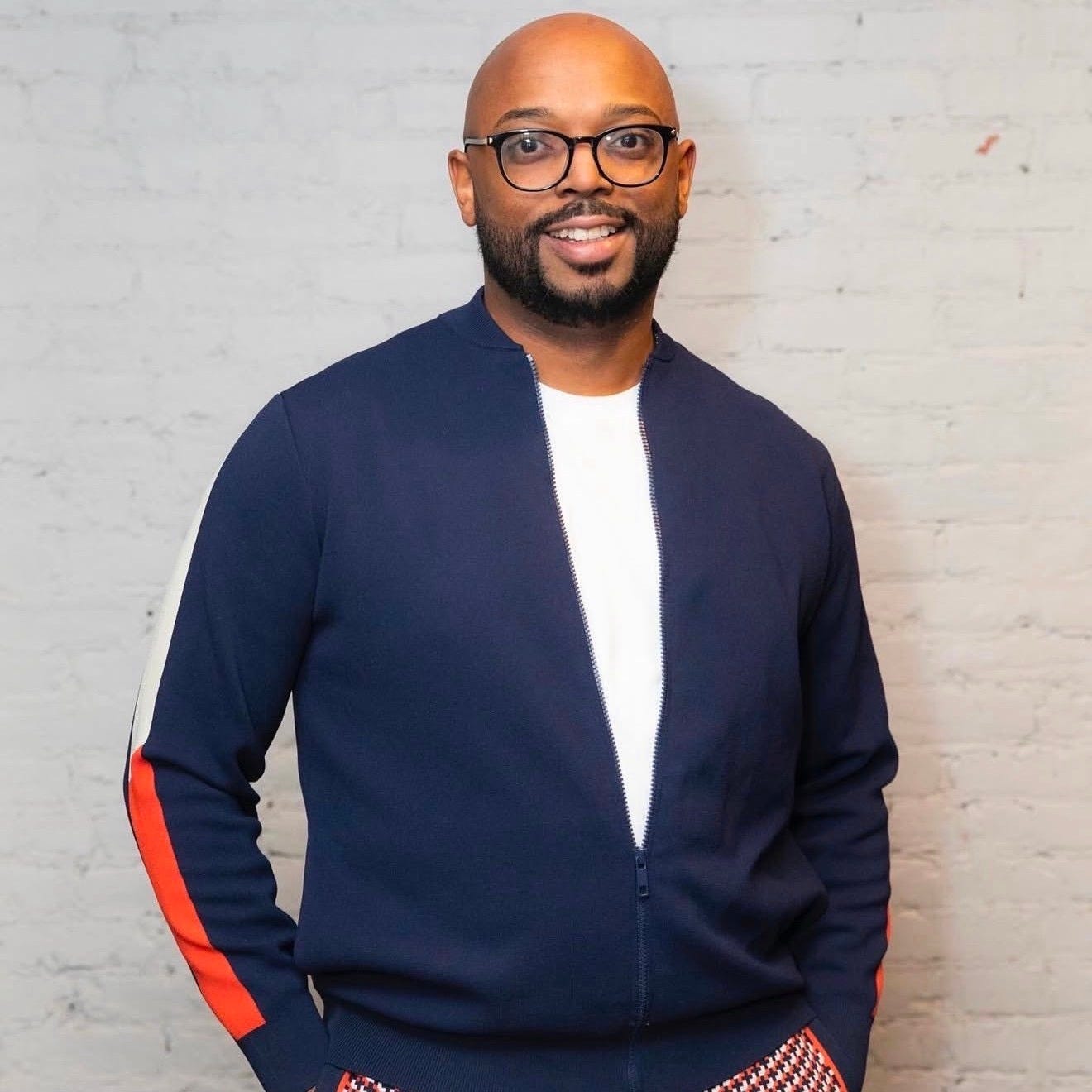
Astead Herndon, a politics reporter and host of the Vox Media podcast “America, Actually,” is now on Substack, where he’ll be writing a “weekly guide to the big ideas and key people behind the political shifts shaping the 2026 elections.”

Musician Lizzy McAlpine has launched a newsletter, The Angel Club, on Substack.
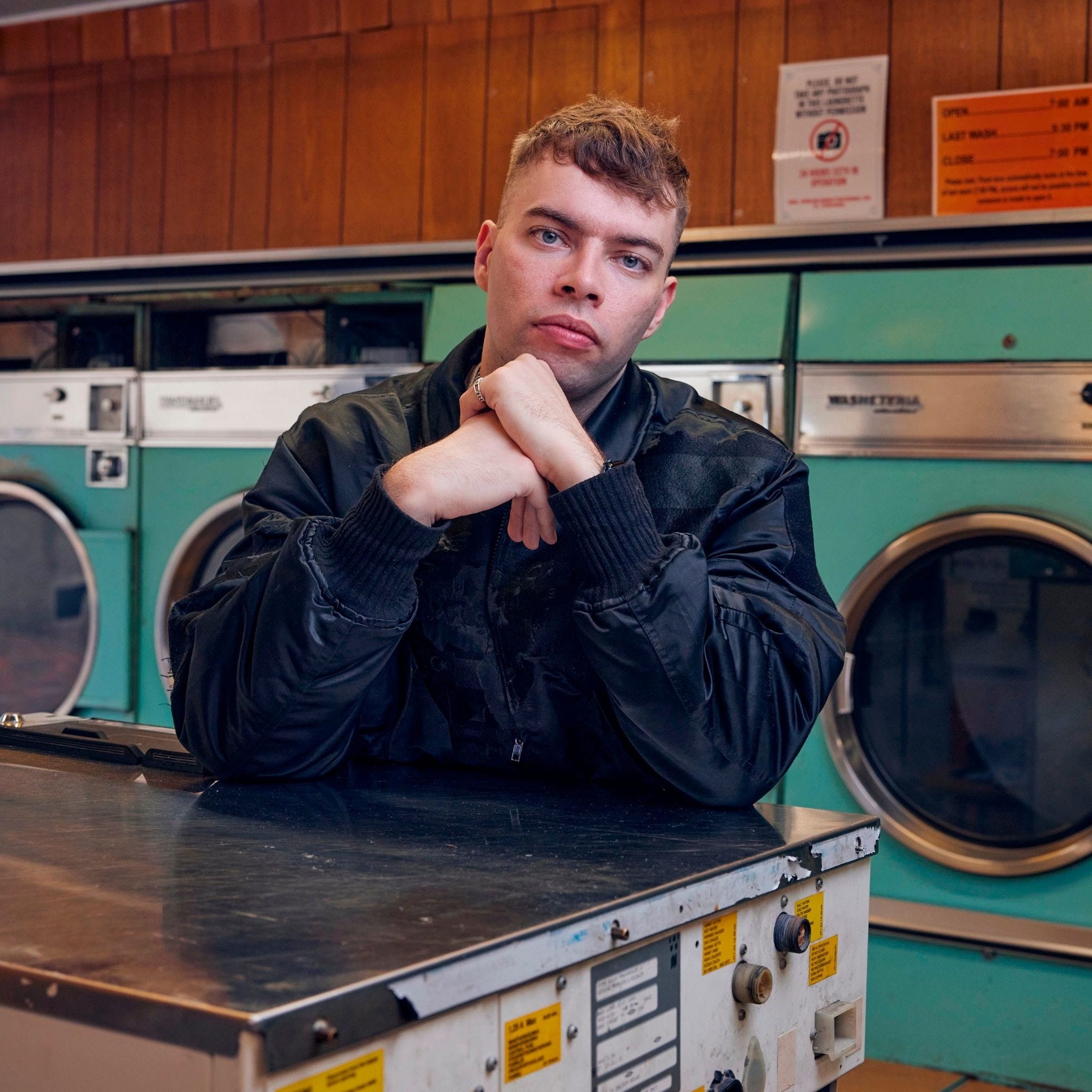
Writer, author, and creator Frankie McNamara has launched Meditations for the Anxious Mind on Substack, where he’ll be posting weekly essays on culture and modern life.
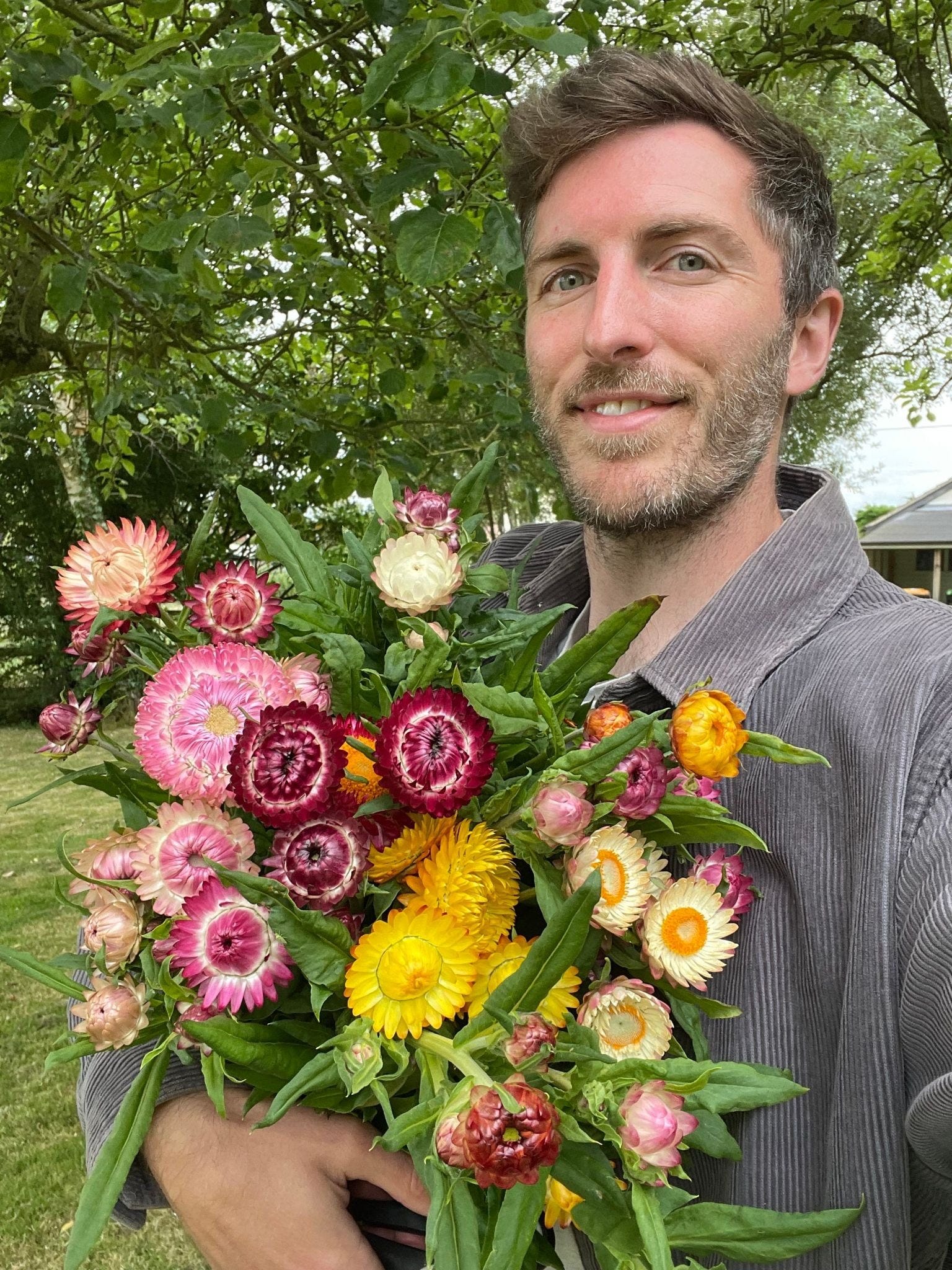
Rob Doing Rob is now sharing nature tips and tricks and glimpses into his “chaotic gardening” on Substack.

Inspired by the writers and creators featured in the Weekender? Starting your own Substack is just a few clicks away:

The Weekender is a weekly roundup of writing, ideas, art, audio, and video from the world of Substack. Posts are recommended by staff and readers, and curated and edited by Danya Issawi out of Substack’s New York office.
Kids have taught us so much.
Screen time is very limited in our home, so our 7-year-old and 10-year-old have to find other ways to entertain themselves besides watching YouTube.
Over time, I started noticing something interesting. Human attention is limited, yet it is one of our most valuable resources.
When screens are no longer the default, kids naturally start paying attention to different things. They notice a dead spider surrounded by ants. They compare a big leaf with a tiny one. They spend time drawing, making up games, and simply playing.
It reminds me that where we place our attention shapes what we see in the world.
There's an entire universe of interpretative sciences where measurement is irrelevant. This statement is simply false. The interpretive sciences are indispensable because human beings do not merely behave; they act within worlds of significance, where words, gestures, obligations, fears, loyalties, rituals, silences, threats, promises, and institutions draw their force from the meanings people assign to them and live through them. To understand social life one must understand the systems of meaning that make conduct intelligible from within it. Measurement is not the relevant concern at that level of analysis, though it may become a welcome contribution once a broader and better-formed set of questions has been established. Think about and learn from Weber, Boas, Malinowski, Evans-Pritchard, Geertz, Douglas, Hymes, Taylor, Carbaugh, Bozeman … on and on and on.