This week, we’re losing our grip on attention, deciding San Francisco’s fate, reviving 19th-century catchphrases, appreciating Geese, and preparing to catch Sinterklaas when he comes down the chimney.
A note: The Weekender will be on hiatus next week. We’ll be back in your inboxes on Saturday, January 3. Happy holidays!
Data doesn’t lie:Believe it or not, the people yearn for more gift guides. According to Substack’s data team, “gift guide” was the most searched-for term this month. A few of the stranger ones we’ve encountered: weird medieval guys shared a weird medieval gift guide. The Scoop’s “Grift Guide,” a sort of hater’s guide to 2025, reviewed “grifts” like the New York Times’s Cooking app claiming it takes five minutes to prepare a salmon and the “vaguely sinister” marketing behind Dubai chocolate. Finally, Kate Baer’s poem “Gift Guide” may not include any helpful links, but it will give you a renewed appreciation for buttered pasta.
ATTENTION
Thinking in tweets
In Blackbird Spyplane, Jonah Weiner considers how technology and social media reshape the way we perceive the world.
For a time, when I was much more active on Twitter than I am now, I’d find myself, e.g., washing dishes and, without wanting to, thinking about various mundane things in the form of tweets. Some nascent half-kernel of an idea would come to me and, like a hack comedian for whom every banal thing is material, I would immediately start working it over for any and all tweet-like potential.
Maybe there was a tiny bit of dish soap left at the bottom of the bottle, and I considered diluting it with water to get it out more easily and make the bottle last longer. I wouldn’t simply think that. Thanks to Twitter, I’d think something exponentially more inane and annoying, such as, “The masculine urge to water down the dish soap…” or “The two genders [picture of brand-new dish soap vs. picture of old diluted dish soap]…” or “Choose your fighter [same two pictures again]…” or “Wake up, babe, new diluted dish soap just dropped” or “Men will dilute the last millimeter of dish soap rather than go to therapy…” or “No but the way I just diluted the dish soap…”
And so on. Just cycling through a procession of dumb, Twitter-borne phraseologies as they ran through my head, like a radio on the fritz skipping stations. It was a bit like I was idly playing a “brain teaser” puzzle, and a bit like my brains were oozing out of my ears. I’d spent so many hours of so many days reading tweets—encountering other people’s thoughts filtered through the specific character limits and idiomatic conventions of that site—that the seams between my own experiences, thoughts, and tweets began, on some level, to delaminate.
I worry that something analogous has happened in my relationship to looking. The same way that an idea would occur to me and I’d immediately reach for a Stock Twitter Phrase to give it form, whenever I see anything that interests me now, there’s a looming sense in which my phone is there with me, framing and constituting the sight, even if I never post the picture, even if I never look at it again and, weirdest of all, even if don’t take out my phone.
The same way I once conditioned myself to think in tweets, I’ve conditioned myself to see in “posts,” in “grid pics,” in “stories,” in flicks texted to the group chat, in .HEICs, and so on.
This is the underside of what people mean when they describe an extremely “sticky” piece of technology: It can stick to you, like the facehugger from Alien, even when you’re not using it.
The mid-19th century was catchphrase heaven. Among them, ‘all serene’, ‘go it you cripples (crutches are cheap)!’, ‘Jim along Josey’, ‘do you see any green in my eye?’ ‘who shot the dog?’ and ‘not in these boots.’ The origins were various, but they sprang mainly from the music hall and from popular plays.
Some, however, had no obvious origin. Such was bender! which appears in 1812 and in effect meant ‘bullshit!’ As defined in James Hardy Vaux’s Vocabulary of the Flash Language, it was ‘an ironical word used in conversation by flash people; as where one party affirms or professes any thing which the other believes to be false or insincere, the latter expresses his incredulity by exclaiming bender! Or, if one asks another to do any act which the latter considers unreasonable or impracticable, he replies, O yes, I’ll do it—bender; meaning, by the addition of the last word, that, in fact, he will do no such thing .’ An ancestor for modernity’s not. By 1835, bender had become over the bender, which apparently reflected a tradition that a declaration made over the (left) elbow, as distinct from not over it, need not be held sacred. The Victorians also used over the left, i.e., pointing with one’s right thumb over one’s left shoulder, implying disbelief.
Charles Mackay’s classic sociological study, Memoirs of Extraordinary Popular Delusions (1841), was especially interested in the phenomenon of catchphrases. Aside from Partridge’s Dictionary of Slang & Unconventional English (1936-84), which included ‘catchphrases’ in its subtitle, his study represents the great single concentration of the type. Mackay (1814-89) was a poet and journalist, who mixed such posts as that of the Times’ special correspondent during the American Civil War with the writing of song lyrics and of a wide variety of books, many on London or the English countryside. The first volume of Memoirs deals with a variety of such delusions—among them religious relics, witch and tulip manias, the crusades and economic ‘bubbles’—and in the second turns to ‘Popular Follies in Great Cities’.
These, it transpires, are catchphrases, which are ‘repeated with delight, and received with laughter, by men with hard hands and dirty faces—by saucy butcher lads and errand-boys—by loose women—by hackney coachmen, cabriolet drivers, and idle fellows who loiter at the corners of streets.’ He also notes that each one ‘seems applicable to every circumstance, and is the universal answer to every question; in short, it is the favourite slang phrase of the day, a phrase that, while its brief season of popularity lasts, throws a dash of fun and frolicsomeness over the existence of squalid poverty and ill-requited labour, and gives them reason to laugh as well as their more fortunate fellows in a higher stage of society. London is peculiarly fertile in this sort of phrases, which spring up suddenly, no one knows exactly in what spot, and pervade the whole population in a few hours, no one knows how.’
Found-object menorahs by David Stark Design, shared by Stephanie
MUSIC
Cameron Winter, Geese, and the greats
In the prelude to an interview with Cameron Winter that touches on Bob Dylan, the Beatles, and Gregorian chants, Grayson Haver Currin explores what makes Winter’s songs so compelling.
A year ago next week, I paid my friend Brad Cook a holiday visit. In another lifetime, we were longtime roommates who briefly ran a record label together, but we now live on opposite sides of the country, married men with jobs and pets, steadily approaching middle age. We stop by when we can.
I’d been there for just a few minutes when Brad asked if I’d heard Cameron Winter’s solo album, Heavy Metal. When I hemmed and hawed about not entirely loving Geese, he told me he agreed but that, still, I needed to listen. Our pal Jake Lenderman had once felt that way about Geese, but he was now obsessed with Heavy Metal and had recommended it to Brad, who, in turn, recommended it to everyone he encountered. So I followed him into his garage, the same space where he’s made records with Mavis Staples, Waxahatchee, Hurray for the Riff Raff, and Snocaps during the last few years. He played “Nausicaä (Love Will Be Revealed)” so loudly that his dog scampered into the next room. Brad grinned: “Isn’t that the best song you’ve heard all year, Gray?” I relented that he might be right.
A few weeks later, Brad texted to ask me if, when I listened to Heavy Metal, I heard Albert Ayler at all. Maybe that seems like a ridiculous question about a piano-playing singer-songwriter who was just barely drinking age, but I remember the day Brad got an enormous Ayler tattoo on his right arm, so I told him to go on. The music, he suggested, almost always moved in vague opposition to Winter’s voice, like two teams pitted against one another on opposite sides of a ball. Brad said this reminded him of Ayler’s great bands, and, again, I had to relent. We talked about what other phantoms we heard in the music, like strains of the late and overlooked Chris Whitley, and wondered if Winter, then 22, had ever heard any of this old-man music. Probably not?
About eight months later, I was sitting with Winter outside of Dinosaur Coffee in Silver Lake. It was the second in a series of long interviews for a GQ profile of Geese, who were a few weeks away from releasing Getting Killed. At one point, I decided to trot out Brad’s theory, and Winter smiled. “That makes perfect sense,” he said, explaining that he felt that way on 3D Country, too, because he was trying to fight against the perfection of the band with what he called unapproachable vocals. “I like that tension.”
Winter wasn’t putting it on, either. Almost instantly, he started talking about Ayler’s polarizing and brilliant New Grass, the gravity of Sonny Sharrock, and the legacy of Ornette Coleman. I envied him a little in that moment. I am 42, meaning that I’m just at the age when learning about Sharrock or Coleman or Merzbow or Angus MacLise (others who came up that day) meant expensive orders from Forced Exposure at the record store where Brad and I worked, not too terribly long ago. But led by voracious listening interests and a predilection to be a student of sound, Winter had not only streamed so much of this relatively obscure stuff but also learned its lessons, internalizing them as he started to make his own music. Maybe they show up in Heavy Metal or Getting Killed, and maybe they don’t; I still sensed he understood a staggering amount about the landscape of somewhat esoteric sound.
I was reminded of this a week ago, when I reviewed Winter’s funny, heavy, sad, sweet, and masterful debut at Carnegie Hall for GQ. In that review, I mentioned how the live renditions of those songs reminded me of the astounding Ukrainian pianist Lubomyr Melnyk (if you don’t know Melnyk’s music, it is a gift for the world) and of black metal at large, music that may seem off-limits for piano songs that, at times, can be called something like pop. Thinking back to those interviews, though, I wouldn’t be surprised if Winter has at least some familiarity with something in those lanes. That’s what, in part, makes his songs so compelling—they pull the unfamiliar into the familiar, feeding an old fire new wood.
Please pay special attention to the cache-nez, or “hide-nose.”
ART HISTORY
The invention of Santa Claus
The Illustration Department breaks down how illustrators slowly transformed Saint Nicholas, the “tiny, pipe-smoking, soot-covered elf” from Clement Clarke Moore’s poem, into the jolly man in red we now know as Santa Claus.
The name “Santa Claus” comes from Sinterklaas—the Dutch nickname for Sint Nikolaas, or Saint Nicholas. Sinterklaas was inspired by Saint Nicholas of Myra, otherwise known as Nicholas of Bari (where my parents are from). St. Nick was known to secretly dole out a gift or two. He often left coins in people’s empty shoes. His biggest claim to fame involved giving three Christian women dowries so they didn’t have to become prostitutes.
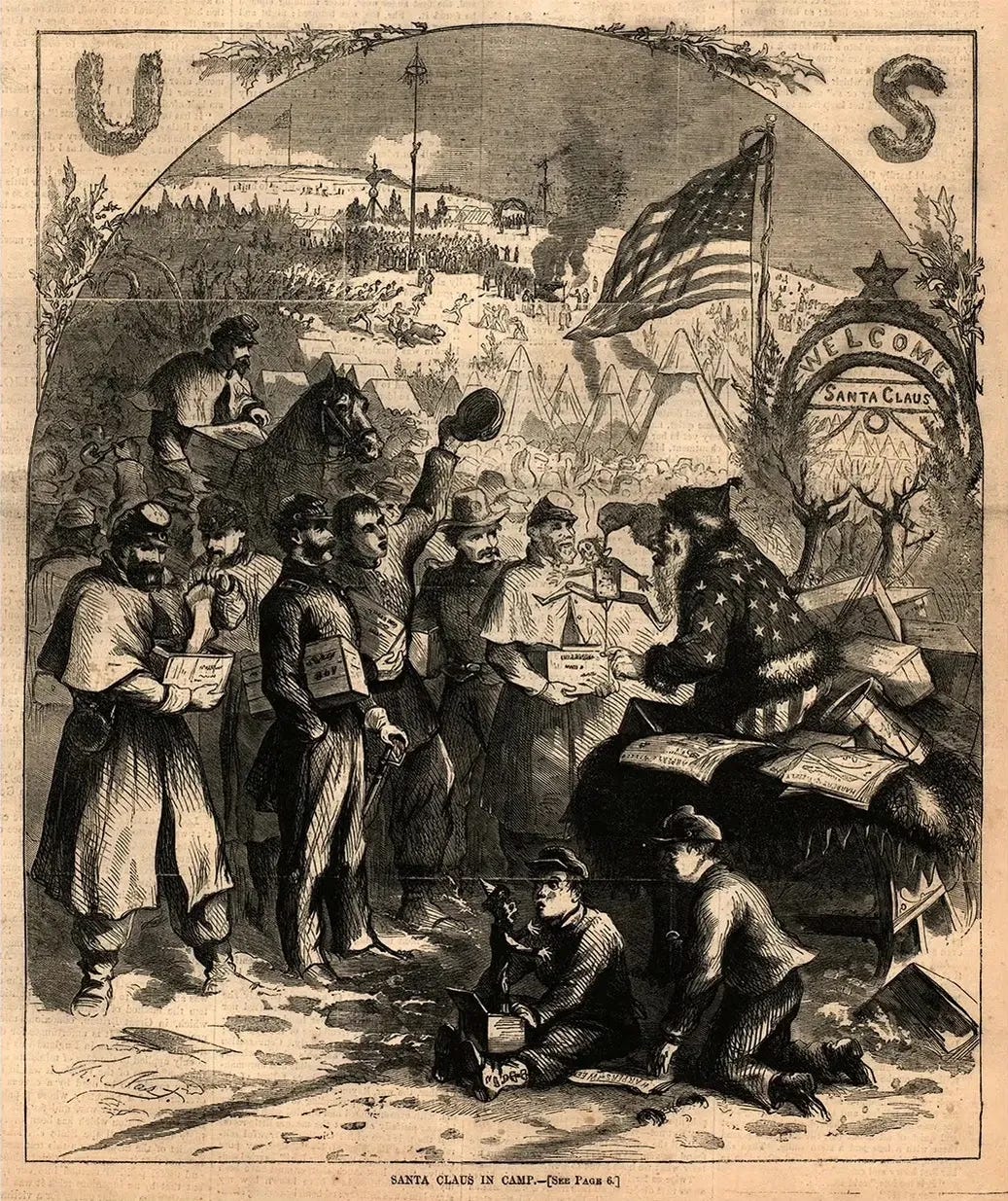
Thomas Nast’s Santa Claus in Camp was the first known, official introduction to modern-day Santa. It appeared in the January 3, 1863, issue of Harper’s Weekly.
“In this image,” wrote librarian and archivist Rachael DiEleuterio, “Santa visits a Union encampment, distributing gifts to soldiers. Most notably, Nast dressed Santa in a coat patterned with stars and trousers striped like the American flag. Santa holds a puppet labeled ‘Jeff,’ a not-so-subtle swipe at Confederate president Jefferson Davis. The message was unmistakable: even Santa supported the Union cause. Over the years, Nast continued to refine and elaborate Santa’s image. His illustrations provided the first known references to Santa living at the North Pole and maintaining a toy workshop—details that soon became fixtures of the Santa Claus mythology.”
Ryan Hyman, a curator at the Macculloch Hall Historical Museum in Nast’s hometown of Morristown, New Jersey, pointed out that Nast fashioned Santa—all bearded and rotund—on himself.
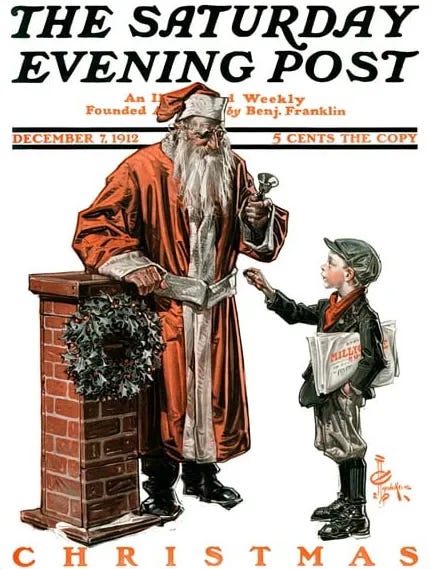
Then, in 1917, the Saturday Evening Post publishes J.C. Leyendecker’s rather svelte sidewalk Santa. He’s clothed in red and white. Why red and white? Well, in those days, a palette of red, yellow, white, and black is all an illustrator needed to create a “full-color” piece. It was faster to paint with a limited palette. And easier (and cheaper) to print.
So, if anything, Santa is red and white today because of creative expediency and printing limitations.
The Weekender is a weekly roundup of writing, ideas, art, audio, and video from the world of Substack. Posts are recommended by staff and readers, and curated and edited by Alex Posey out of Substack’s headquarters in San Francisco.
Got a Substack post to recommend? Tell us about it in the comments.
I highly recommend Naval's Archive. You never run out of inspiration, and it feels like finding a likeminded friend. Actually, finding likeminded spirits might be one of the most joyful things in life.
Nice article. Thank you. I have to say Happy Holidays. Especially during this time of distress of many who won’t have a Christmas. Retribution is a foot in this land . People who have been through the worst times in their lives. It’s apparent this administration doesn’t understand how much the people of this country have gone through. They incase themselves in hurting others. I can’t wait until the next election when they find out that retribution is not a time for the holiday’s to hurt people in this country instead we should give them hope ! No matter how many people have been hurt!






















I highly recommend Naval's Archive. You never run out of inspiration, and it feels like finding a likeminded friend. Actually, finding likeminded spirits might be one of the most joyful things in life.
Nice article. Thank you. I have to say Happy Holidays. Especially during this time of distress of many who won’t have a Christmas. Retribution is a foot in this land . People who have been through the worst times in their lives. It’s apparent this administration doesn’t understand how much the people of this country have gone through. They incase themselves in hurting others. I can’t wait until the next election when they find out that retribution is not a time for the holiday’s to hurt people in this country instead we should give them hope ! No matter how many people have been hurt!