Hey, it’s Mo Diggs. I like to compare today’s media landscape with that of the past because time is cyclical and the past is prologue.
Excited and honored to guest curate the Memorial Day weekend edition of The Weekender. I’ve got an eclectic assortment of essays, short-form posts, podcasts, and even a little literature to fully stimulate your palate.
TECHNOLOGY
The oracle of the matrix
It is easier to write the Great American Novel than it is to have a fresh perspective on tech. There are so many posts simply blaming smartphones for all our maladies, you wonder if there is a lobbying group behind them. Katherine Dee consistently astounds me with her boundless sagacity. Here, she illustrates how the current chatbot craze is a return to animism, which has been repressed for centuries and before now was primarily dealt with through puppets. I do not take drugs anymore, but the way I say “Wow man” when I read her on the L train must have passengers thinking otherwise.
There is a wave of books asking how social media platforms shape the stories we tell about ourselves and, through that shaping, what new kind of self they are producing. Megan Garber’s Screen People argues that the language and ethos of entertainment have permeated every aspect of life, so that we now see each other as characters in an ongoing show whose continuity we are responsible for maintaining. Kathryn Jezer-Morton’s The Story of Your Life, out in August, makes the related case that algorithmic platforms have disciplined what counts as a shareable experience into what Jia Tolentino’s blurb calls a “rigid, optimized, phone-shaped norm.” I haven’t read either yet, but I’m willing to bet they’re basically right. It’s a topic I’ve written about myself.
We think in a televisual frame: Spotify provides the soundtrack of our lives, we accuse people of “main character syndrome,” we reference the invisible “writers’ room” and “seasons” constantly.
If television introduced this framing, then social media fortified it.
I think this is the last critique of social media we’re going to get. The era in which we treated our screen-lives as fake is ending. Not because anyone won the argument, but because the objects on the other side of the screen have started to seem like they have interiors of their own—and that pull, I’ll argue, is dragging us back into our bodies rather than further into the feed. In fact, I will say this: social media as we know it is dead. Technology-saturated lives are not.
Daniel Falatko is one of the funniest people on Substack. He doesn’t post as often as I would like him to on his newsletter, but his Notes run is the stuff of legend. He often recaps the Bret Easton Ellis podcast and shares mordant observations on trap music and jazz, but my favorite notes of his are haiku-length sketches of Bushwick life like this one, where he can’t hide his momentary obsession with a colorful subway passenger.
Prester John Andrews is one of my favorite culture writers on here. He’s refreshingly unpretentious yet insightful. His podcast interview with Substack wunderkind Russell Sprout is particularly fascinating. Sprout explains how his first-ever Sproutstack post, “Is Mike Wazowski Jewish or Polish?,” went viral. This is the diametric opposite of my come-up on Substack. For more than a year, I began my newsletter posting into an indifferent void, but I kept doing it to shut up my friend Trafton Crandall, who also has a Substack. Then I fatefully linked to one of Ross Barkan’s Guardian articles. I was not aware that he was already a subscriber of mine, so he began linking to me and almost single-handedly gave me my current readership. What Sprout and I have in common, if not beginner’s luck, is that we both posted. Don’t get hung up on how often you have to write—just shut up and do it.
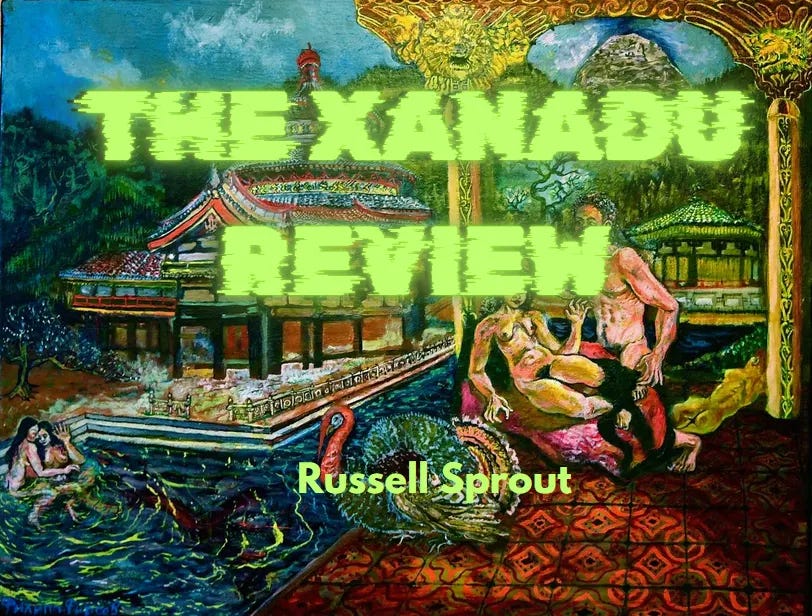
In today’s episode of The Xanadu Review, I’m joined by Russell Sprout. We talk Gilmore Girls (and why Emily Gilmore has done nothing wrong, ever), how the medium of how we consume art changes the experience, the album experience as the theft of cows by vampires, the depressing but funny future of aging millennials, the Palantir manifesto, the tech world and startup culture, “abundance” and the future of normies, the 2020s as a secular religious revival and much, much more!
It is hard to choose just one great post from culture magazine The Metropolitan Review, but this review of Cairo Smith’s book Scenebux by ARX-Han is something else. One of my worst posts was a dumb manifesto I wrote calling for Lit 2.0. The basic idea was a literature that treated the internet as a part of our lives, without the desperate attempts to re-create 4chan-speak that seemed to plague much of the literature of the early part of this decade. Scenebux seems to be doing a fine job of painting a more lived-in reflection of life around the internet, where people still smoke and curse and have sex. Han’s review does what all good criticism does: gives you the proper framing for understanding why a work is worthy of discussion, let alone an outright purchase.
Seldom does a book predict its imminent descent into textual illegibility, but Cairo Smith’s Scenebux ends with an interesting flourish I have yet to see in other similar works—an afterword containing a lengthy list of references that are “extremely specifically situated in time from the death of Pope Francis to mid-July of 2025.”
The effect is to create a map-like web of ephemeral signposts and hyper-localized cultural references, sufficiently layered such that even the Extremely Online reader will find it hard to catch all or even most of them.
Scenebux is a short, snappy novella about a young underemployed writer named Ben Extina who embarks on a modern Pynchonesque tour of “the scene,” or the contemporary online ecosystem of niche intellectual figures. This landscape is primarily focused on a lively anatomical slice of a particular right-coded intellectual subculture backed by A Certain Silicon Valley Oligarch, but isn’t fixated on a single persona or figure—the novella’s center is its rapid momentum and flurry of events, scene changes, and characters.
In this respect, Scenebux isn’t quite situated as an internet novel, since the online intellectuals that Smith is referencing are corporeal characters that the protagonist meets in real life. Here the novel encompasses a broader effort to recapture the dynamic, gonzo-style hijinks of 20th-century protagonists who experienced the world through acts of human agency rather than the graphical user interface of a screen or the surprisingly passive creative-class jobs that seem to dominate book jacket summaries these days.
I love reading about improv, almost more than I love watching it. Will Hines describes here a technique that not only leads to bad improv comedy but, though he doesn’t say it, to bad Saturday Night Live sketches: an impatience to point out and overstate the weird part. Most of my favorite comedic moments sucker punch me with their weirdness; by the time I realize something is off, I am already laughing.
Sometimes improvisers use the idea of “framing” to try and write the whole scene themselves. That is… not good.
Framing is when you call attention to someone else’s unusual behavior. It’s a term I first heard of from the UCB Manual in 2013 (“letting your scene partner know you think they’ve done something unusual”).
Framing: I Hear You
Often you’re telling the other person that you’ve heard them. Like “Got it. I see that you’re trying to be unusual.”
Player 1: I shouldn’t have to pay taxes. I am an artist.
Player 2: (framing) I think you’re taking the idea of “artist” a little too far.
Framing: Did You Notice This?
Sometimes you frame behavior the other person did by accident.
Player 1: I shouldn’t have to pay taxes. I am an artist. Just like Paul Bunyan.
Player 2: (framing) Wasn’t Paul Bunyan a lumberjack? Also fictional?
Player 1: (changing now because of the frame) I consider lumberjacks to be artists. I long to be a lumberjack. I also long to be fictional.
Ted Hope has been a tireless advocate for filmmakers on Substack with his ambitious NonDē (for “non-dependent”) film movement. I was first introduced to this movement by Alex Rollins Berg, whose newsletter Underexposed is a must-read for any film buff. This post breaks down the rise and fall not of a particular movie star, but the entire concept of movie stars. Thrilling though it might be to root for their demise, Berg suggests how they might be our unlikely allies in the fight against corporate conglomerates and Big Tech.
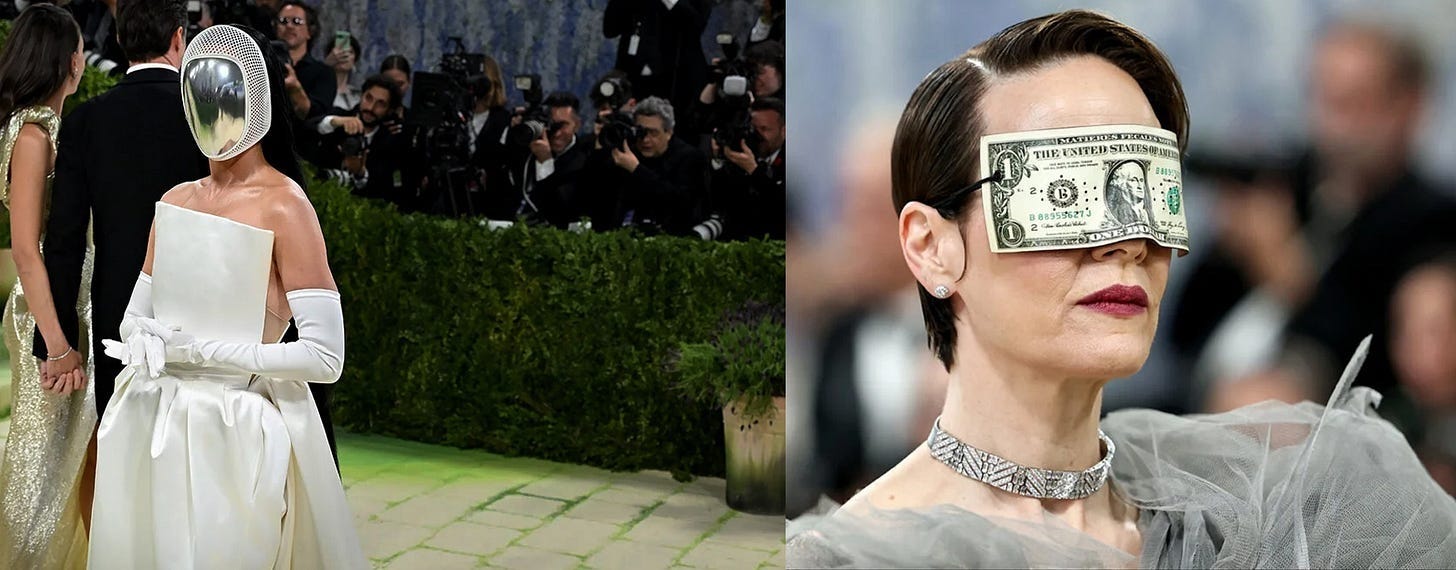
For more than fifty years, the first Monday in May has belonged to the Met Gala. It was former Vogue editor Diana Vreeland who, in the 1970s, transformed the charity dinner into an extravagant pageant of fashion and celebrity, a torch Anna Wintour carries to this day.
That flame flickered earlier this month when several A-listers—including Meryl Streep, Zendaya, Timothée Chalamet, and Taraji P. Henson—shunned the event.
In truth, enthusiasm for the Met Gala has been thinning for some while. Many blame the intrusion of influencers in recent years. Others have pointed to mounting discomfort with the optics: a shameless circus of wealth, made more conspicuous this year by honorary ringleader Jeff Bezos, whose status as a tax-averse centibillionaire rendered the evening a tasty vessel for broader cultural resentment.
The backlash reflects not just the Gala’s fading luster but the crumbling architecture of celebrity itself. In the first quarter of the 21st century, Hollywood star power has been steadily marked down. The rise of IP, the flattening force of streaming, the deluge of preening, jabbering TikTok celebrities, and now the threat of AI have chipped the marbled plinths of our idols down to nubs. Once, they loomed large above us; now they flicker on our phone screens, at the mercy of our giant thumbs.
There are good reasons to welcome this decline. Predators have been toppled. Toxic behavior has been exposed. Performative virtue signaling has fallen blissfully silent.
And yet the film industry depends on the perceived market value of recognizable actors to finance movies—particularly original, challenging, artistically ambitious movies that directors like yours truly are fighting to make.
Alexander Sorondo has a wonderful profile of Robert Moses and LBJ biographer Robert Caro on his Substack, big reader bad grades. Those posts are paywalled, but his affecting, lyrical sketches of life working in a Miami grocery store are surprisingly free to read. The post here focuses on an employee with a learning disability who gets away with not working as a result of his condition. Sorondo’s radical empathy has the reader commiserate with the exasperated staff while also rooting for the holy fool who bites produce and puts it back on the shelves.
Our new hire at the grocery store appears to have a learning disability. He is egoless and polite. To say that he’s “innocent” feels condescending, but the word comes to mind a lot because he’s making everyone furious at the fact that he doesn’t do anything. Just starts a task and then wanders off. In the break room, eating lunch, people trade lockjawed whispers about how he comes back here every ten or fifteen minutes, opens his locker, lifts his shirt to just above his nipples and applies deodorant, then spritzes himself with cologne, then opens the fridge and scans the shelves. There’s a can of whipped cream with STAFF scrawled across the label in Sharpie. He tips his head back and shoots a jet into his mouth from two or three inches high and then puts it back and returns to work, except that “work” in this case means walking laps around the store saying “Hi How Are You” to everybody and improvising tasks that he does not complete.
It seems like he is knowingly doing nothing, like he’s well-practiced at performing busyness without getting anything done; and yet if you put it in those terms (“practiced,” “performing”) it sounds insidious.
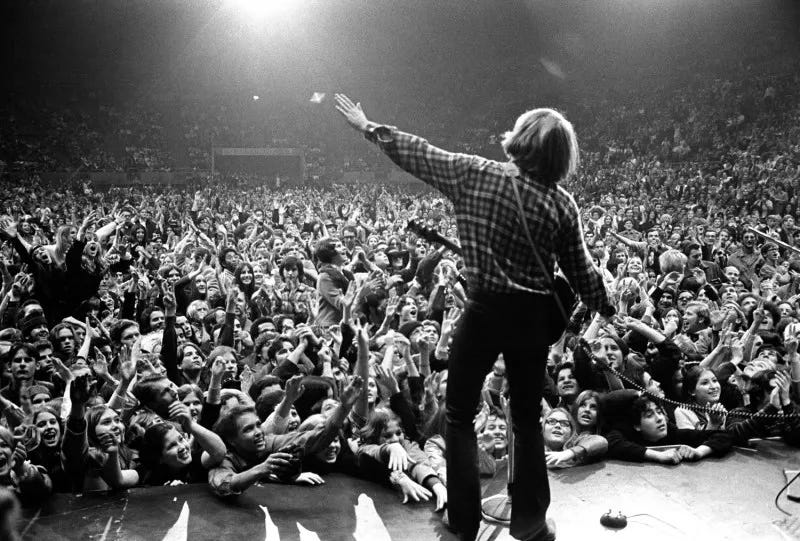
The Rock & Roll Hall of Fame just launched on Substack, opening its vault with liner notes, oral histories, deep dives into artifacts, and behind-the-scenes stories from the museum’s staff and inductees.
Inspired by the writers and creators featured in the Weekender? Starting your own Substack is just a few clicks away:
The Weekender is a weekly roundup of writing, ideas, art, audio, and video from the world of Substack. Posts are recommended by staff and readers, and curated and edited by Substack’s editorial team.




















Thanks for the shout-out, Mo!
All of the art is so beautiful, photos, paintings and words, just gorgeous! Thank you Mr. Mo!