

“Conspiracy theories are the true Great American Art Form”
In this edition of the Weekender: navigating Shakespearean traffic, ranking conspiracy theories, and a post-apocalyptic short story


This week, we’re rating conspiracy theories, getting stuck in 16th-century traffic, and exploring the AI enthusiasm gap between China and the U.S.

THE DISCOURSE
Briefly noted
In Pursuit brings former U.S. presidents to Substack: In honor of America’s 250th anniversary, the bipartisan group More Perfect has launched a new essay series penned by American public figures and scholars. First up: George W. Bush shared his thoughts on another George W., praising Washington for his humility and wisdom in voluntarily stepping away from power—praise that some have read as a veiled rebuke to the current administration. In Pursuit has many more essays on the docket, including those by former presidents Barack Obama and Bill Clinton, Chief Justice John Roberts, former first ladies, and other leading historians and public figures.
Maxximizing: We’ve gone from looksmaxxing to Infinite Jestermaxxing. Horsemaxxing. Symphonymaxxing. Anne of Green Gablesmaxxing. Je ne sais quoi maxxing. We are rough beasts, slouchmaxxing towards Bethlehem. Someone, for some reason, has tried Gaddafimaxxing. Have we finally flymaxxed too close to the sun?


CONSPIRACIES
A Great American Art Form
The Kennedys are, yet again, having a moment: RFK Jr. is doing ads with Kid Rock, and Ryan Murphy’s new series about JFK Jr. and Carolyn Bessette Kennedy is on screens across the country. Meanwhile, Max Nussenbaum revisits the family’s starring role in America’s greatest art form: conspiracy theories.
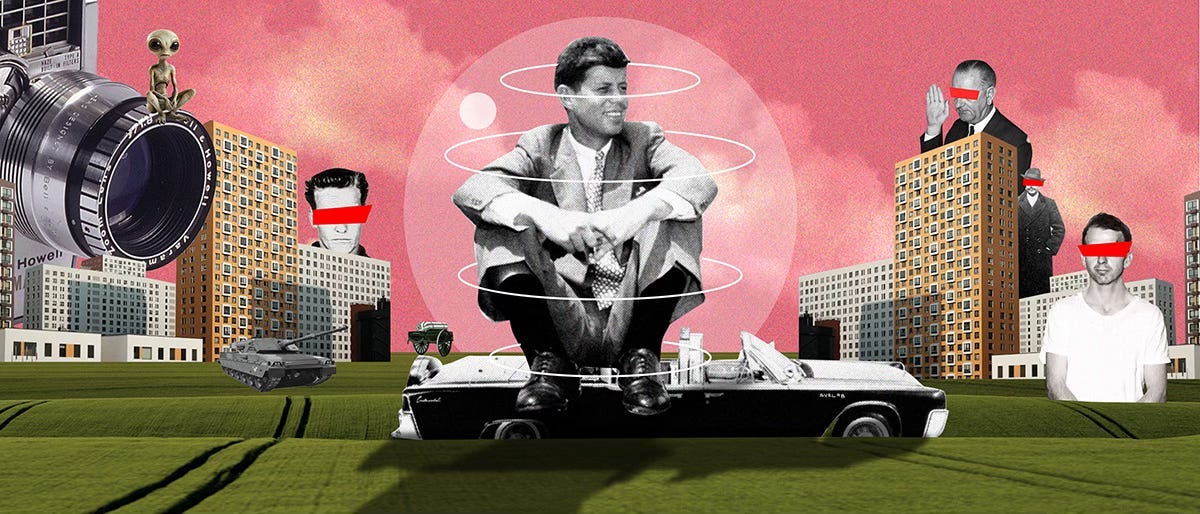
JFK Assassination Conspiracy Theories, Reviewed
—Max Nussenbaum in Candy for Breakfast
Forget jazz, Broadway, comics, or hip-hop—in my book, conspiracy theories are the true Great American Art Form. This country was practically built for them: start with a deep-seated distrust of authority, stir in the Protestant idea of unmediated access to individual truth, and top with the First Amendment to let it all bloom in public.
You could even say the United States itself was founded on a conspiracy theory: the Founding Fathers wove a tale of powerful elites (King George) secretly plotting against ordinary people (the colonists) to advance a villainous scheme (subjugate them through oppressive taxation and military control). As with many conspiracy theories, there’s a kernel of truth to this story—but the reality is that what the founders interpreted (or spun) as a deliberate plot against them was really just a patchwork of clumsy, improvised policies from a disorganized British government.
If conspiracy theories are the Great American Art Form, there’s no question as to which is the canonical work of art—our Kind of Blue, West Side Story, Superman, and Illmatic all rolled into one: the theories surrounding the 1963 assassination of our third-best president named “John,” John Fitzgerald Kennedy. The belief that Lee Harvey Oswald didn’t act alone is the country’s most widely believed conspiracy theory—if, indeed, it even is a conspiracy theory—sustained across generations and deeply woven into American cultural memory through countless books, movies, and TV shows.
In fact, we even have the Kennedy assassination to thank for the term “conspiracy theory” entering widespread use in the first place: as revealed by a declassified 1967 document, the CIA encouraged the use of the then-obscure phrase as a pejorative term to discredit critics of the official narrative.
In his book Reclaiming History, Manson prosecutor and best-selling true crime author Vincent Bugliosi cites 44 different organizations and 214 specific individuals who have been accused of conspiring to assassinate Kennedy, including the Nazis, the Teamsters, the French OAS, Watergate plotter E. Howard Hunt, and Dr. George Burkley, Kennedy’s personal physician. Needless to say, this review will not manage to investigate all of them. The limits of time, space, and human sanity will sadly constrain me to just ten of the most well-known conspiracy theories, which I will evaluate both for plausibility and—far more importantly—for entertainment value.

FULL CIRCLE

HISTORY
“Traffic’s thy god”
Callan Davies on how Shakespeare got to work, and what it tells us about traffic, horses, and a rapidly changing world.
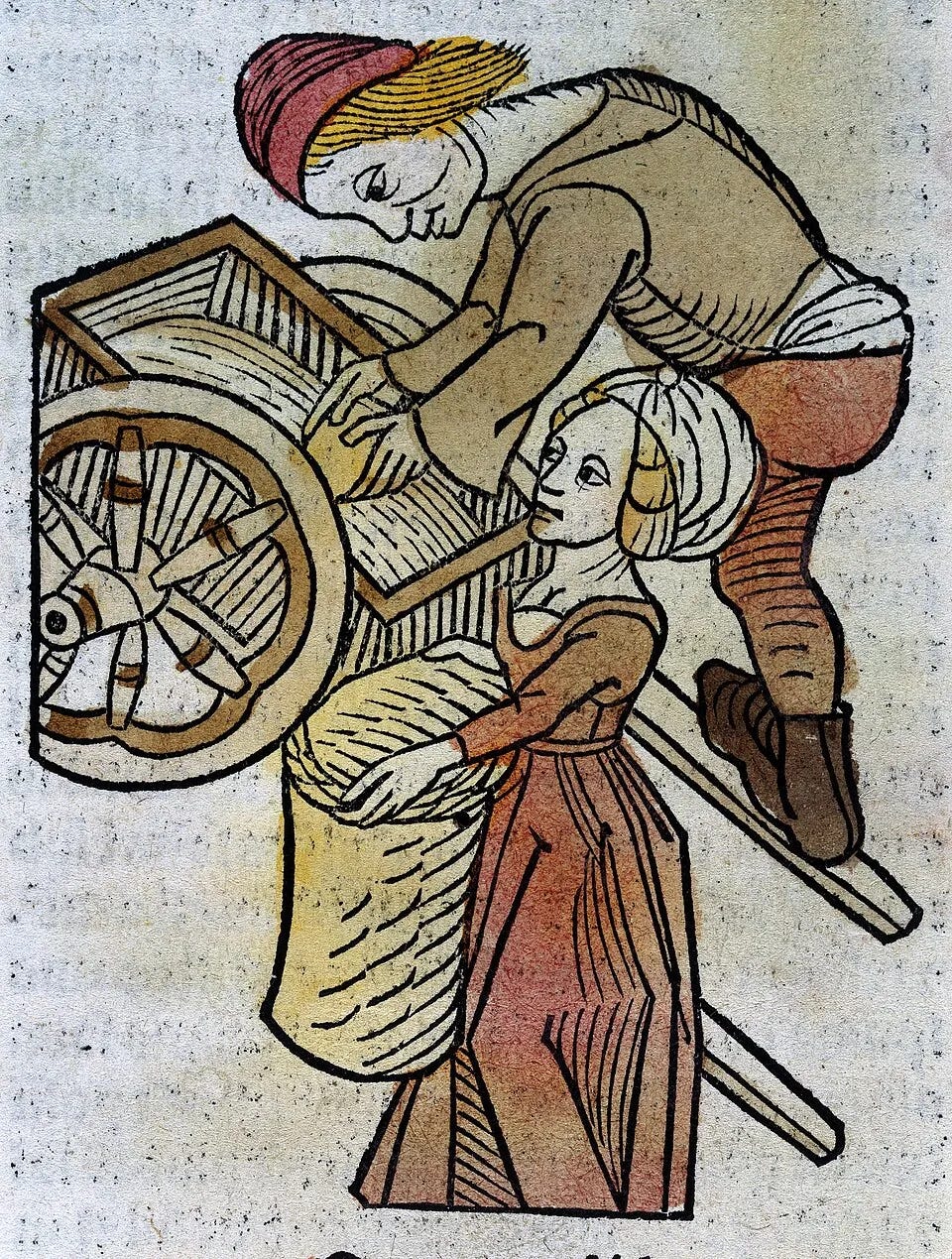
A Shakespearean History of Traffic
—Dr Callan Davies in The Shakespeare Stage
Thomas was born around 1514, and he testified at the age of 70 in 1584 about some property issues. Over this time, he would have felt keenly the traffic explosion that characterised sixteenth-century England. The term itself took on association in Thomas’s youth with the ever-expanding commercial movement of goods, coming to stand in for all sorts of kinetic trade. Shakespeare even borrows it to refer to dramatic action itself, setting up “the two hours’ traffic of our stage” (Romeo and Juliet, Prologue, l.12). This was the age of traffic, both in the global and colonial expansion of merchandising and in our more modern sense of a glut of people and vehicles on the move. As the cynical philosopher Apemanthus in Timon of Athens puts it, chiding a merchant, “Traffic’s thy god”! (1.1.239).
All this had me wondering (as I often do) quite what it would be like for the average player or playgoer to commute in the 1580s or 1590s: how did Shakespeare make it from his home off Bishopsgate Street to the Theatre or Curtain in Shoreditch, or to Stratford-upon-Avon? How did individuals travel from Southwark south of the river up north or west? Could Shakespeare ride a horse? (Almost certainly, but how did this come about?)
Was horse-riding like learning to drive at 17? Did you borrow your parents’ nag for the odd journey? Who taught you to ride and was there a formalised “mode”? Plenty of clues exist for more elite riders. Horse-riding manuals and fashionable continental riding styles proliferated across this period. But what about, say, a journeyman shoemaker? A farm labourer? The son of a glover?
As our Shoreditch carter looked on at a playhouse being built next door, he saw (perhaps not coincidentally) his own work in the carrying trade change rapidly. The historian Joan Thirsk points out that the average horse rider on a road in 1500 was almost certainly a gentry figure; by 1600, it was most likely someone of lower middle social status or below going about their business. In just 100 years, horse-riding became democratised; it became “blue-collared.”
Much of this was driven by a growing economy and a rapidly growing population. (And a growing gentility about travel: why drive when you can be driven?) Horses were needed for all sorts of workaday functions (and also for war preparedness over a century of regular geopolitical instability... topical echoes abound). London felt expansion most sharply, more or less doubling in size (to 200,000 residents) in the twenty years from 1580 to 1600. These factors shaped the playing industry, too. There are no crowds without traffic.

PAINTING

TECHNOLOGY
The AI enthusiasm gap
Afra on why Chinese society—from art-house filmmakers to hundreds of millions of Spring Festival Gala viewers—is broadly optimistic about AI, while Americans remain conflicted, if not outright hostile.
An AI-Maxi New Year
—afra in Concurrent
It’s Chinese New Year, and my timeline is dominated by two names: Jia Zhangke and Unitree.
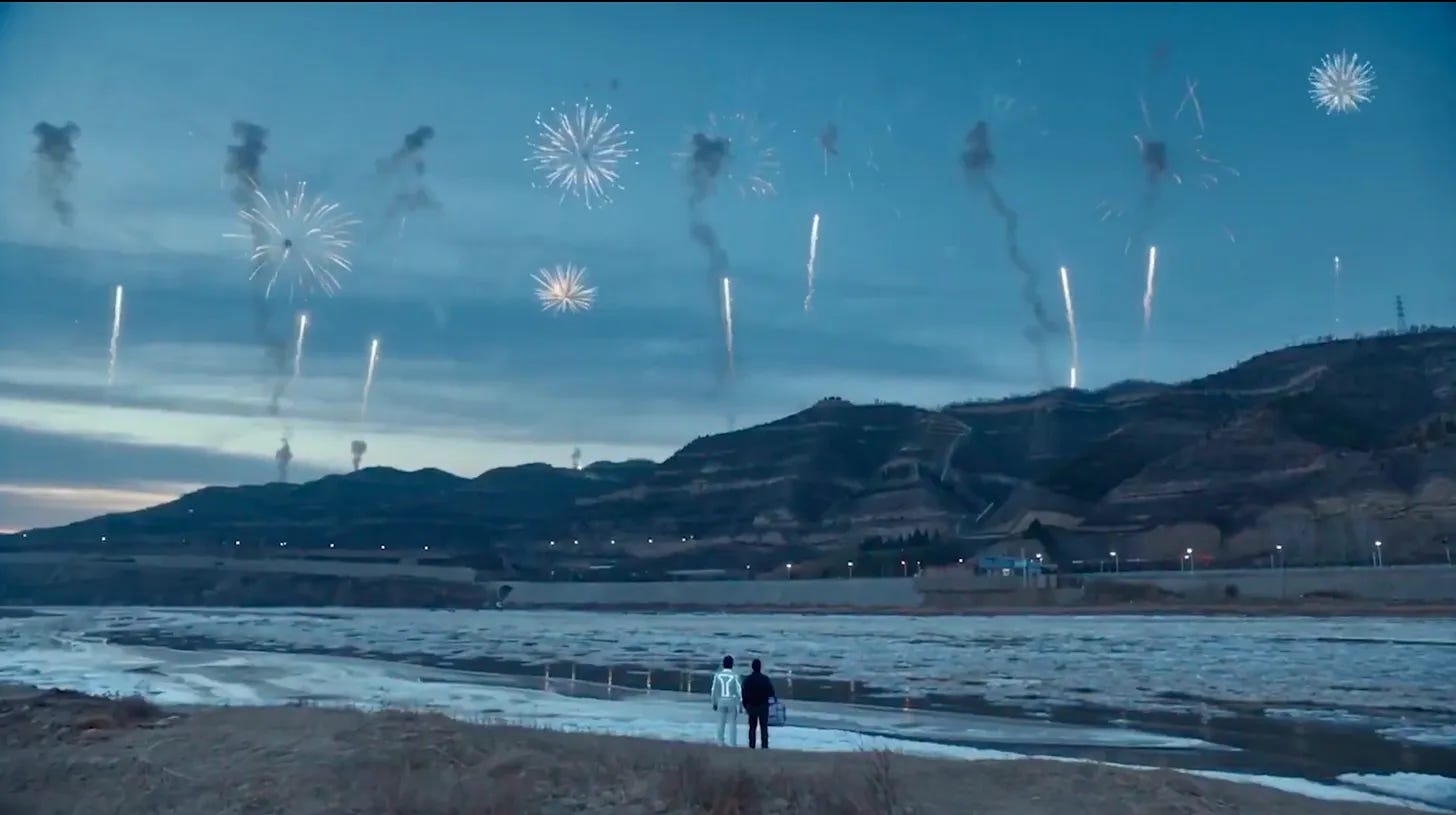
Jia Zhangke, the 55-year-old director whose melancholic, unhurried gaze at ordinary Chinese life has long mesmerized Western cinephiles—turns out to be, of all things, very AI-pilled. This is not an obvious move for a filmmaker whose greatest works are elegies for what Chinese modernization has destroyed. But during this holiday, he publicly praised Seedance, ByteDance’s AI video generation tool, and then released a short film made entirely with it. The film is a conversation between two selves: the plain, conservative Jia, thermos flask in hand, and a younger, healthier, optimistic “AI Jia,” debating the nature of filmmaking. In the final scene, the two Jia Zhangkes stand on the shore of the ice-choked Yellow River, a landscape he has returned to across decades of work in Shanxi province, watching fireworks climb into the sky. The palette is his own: subdued long shots, blue-gray hills receding into the distance. The dual selves wish each other a happy new year. The artist has metabolized the technology into something unmistakably his.
The other story is Unitree.
This is the second year the company’s robots have performed at the Spring Festival Gala, an event that functions as something like the Super Bowl fused with a state address, held annually. I consider the Gala an ultimate “mid-curve” aesthetic, a cultural common denominator. This year’s gala was aggressively AI-maxi. The Unitree G1 humanoid robots performed kung fu, parkour, street dance, and weapons routines with nunchucks and staffs—clips that ricocheted through Western AI communities within hours; many joked “we are cooked”. For a robotics company locked in brutal domestic competition, a Gala slot is a coronation. Meanwhile, the gala itself served as a showcase for Seedance at scale: the segment “Blessing of the Flower God” summoned twelve ancient poets, each reciting verse to honor a flower of their birth month, with AI-generated imagery blended near-seamlessly into the live stage. Later I learned that Seedance had contributed backgrounds, transitions, and generated sequences to at least three other performances. The whole production felt less like a variety show than a national stress test of ByteDance’s compute architecture.
When my partner and I were watching the Gala last night, he said it felt too tech-infused—it reminded him of The Jetsons, the 1960s cartoon with its relentless, cheerful obsession with a technological utopia. I think he’s underselling it. What I see in China right now is closer to Victorian Britain: a society exuding moral seriousness and deep belief in modernization and technological uplift.
What connects these stories is what they reveal about disposition. The Chinese society, from a world-renowned auteur to the hundreds of millions watching the Gala, is broadly, strikingly optimistic about AI. The reflexive existential dread so pervasive in Western discourse is largely absent.
I remember I spent some time browsing Unitree’s Xiaohongshu account to see how the company addresses the Chinese public, especially about anxiety about job displacement. Turns out, there’s nearly none. The feed is wall-to-wall spectacle: humanoid robots and robot dogs performing in extreme weather, doing impressive gymnastics. The comment sections, meanwhile, are a gathering place for the self-deprecating humor of Chinese internet users. Young people ask: When can I ride the robot dog to buy groceries? When will you release a robot nanny? (Since they aren’t getting married or having children.) And, inevitably: “We need robots for elderly care, it’s urgent, please Boss Wang (means Wang Xingxing, the founder of Unitree), speed up production so the robots can look after us in old age.”
Set this against the posture of Jia Zhangke’s rough American counterparts. On a recent Joe Rogan episode, Ben Affleck and Matt Damon discussed AI filmmaking with open contempt. AI output is “shitty,” Affleck argued, because it regresses to the mean by nature—and when AI becomes ubiquitous, “people will actually value real things made by real people even more.” Meanwhile, the Motion Picture Association has accused Seedance of “unauthorized use of U.S. copyrighted works on a massive scale,” and Disney has alleged that ByteDance effectively packaged a pirated library of its characters into the tool. The resistance is creative, institutional, legal, and corporate—arriving from all directions at once.
Can we find an American Jia Zhangke? And if one existed, would they survive the anti-AI public siege? Where American AI optimism does exist, it is confined almost entirely to Silicon Valley—the OpenClaw frenzy, the collective Claude Code psychosis, and if you reach back a bit, the 3-year-old “The Techno-Optimist Manifesto,” a self-enclosed declaration that humanity ought to ride the technological trajectory forward, though who “we” are and why we “ought to” remain thoroughly unexamined. What you see is a cultishly bullish tech elite producing manifestos that fail to persuade the rest of the country, set against a China where the public, the government, and the tech industry are broadly synchronized.
Why such different orientations? It would be easy—and cheesy—to credit propaganda alone, as when Palmer Luckey declared that China’s most powerful weapon is “their ability to control people’s minds through the media.” China’s online discourse is heavily constrained, and voices that sound anything like Western liberal humanism or degrowth are unlikely to survive moderation. But this explanation is too thin to hold. Decades of lived experience have taught Chinese society an empirical lesson: technology makes life tangibly better. I once wrote about my Shandong grandmother, now in her eighties, who once walked five hours to buy a clock so her children could get to school on time. Today her Xiaomi phone has given her an online shopping addiction, and delivery drones fly above her apartment. For many in China, industrialization compressed and bent time itself—and AI simply looks like the next turn of a wheel that has only ever spun forward.

SPACE RACE

FICTION
After the fall
Michael McSweeney’s short story imagines Boston after an invasion: a skeleton newspaper crew, a seed convoy through occupied Massachusetts, and three women with rifles blocking the road.

Dispatch
—Michael McSweeney in Commonwealth Junction
Eight months after the invasion failed, our newspaper had electricity again. Someone in the Army’s logistics division owed my editor-in-chief a favor and in exchange for some promised puff pieces they agreed to connect the building with our sole working printer to the fragile power grid. The printer was a tiny machine, a by-now ancient letterpress kept in a storeroom we affectionately dubbed the museum, but it fed two dozen one-page news prints an hour into our grateful, ink-stained hands. Before this we published the paper by hand, with whatever we had on hand. The shreds of cardboard boxes, old envelopes pilfered from Post Offices, or the blank pages of legal orders we found in a backroom at the municipal court. With power, we approached something more consistent, and now we could work at night. We estimated an official circulation of about 500, an amount we considered a small miracle, though we told ourselves we easily reached half of Boston. People devoured our editions at the ration stations set up in the rubble of the Common and the worksite at the Waterfront where soldiers and civilians were lifting one of the invaders’ landing craft out of the harbor. I even sketched the landing craft, a dark and wart-pocked spear-point, and got it printed in the morning edition.
Let it be said that humanity will never lose its curiosity. Nor will true journalists lose their desire to feed that curiosity, to create and deliver the news. The invasion had shattered the public internet, though a source once told me a few satellites up there still worked, and all the easy links between people were gone with it. Everyone, myself included, kept reaching for our pockets to connect, to feel the hive mind, to feel happy or angry or sad together. We intended to rebuild these connections through the stories people told us. Meteoric terrors descending from the sky. Family members dragged away. Lakes and rivers drained down to fish bones. I interviewed a woman who shot her husband rather than see him bleed to death after an invader sliced through the door he was barricading and severed his arm. I interviewed a fifteen-year-old boy who dragged his unconscious grandfather into a swamp and hid for a week, surviving on scalding rainwater and tree bark. We printed everything. I believed everything.
One day I got a tip about a shipment of seeds and fertilizer out to Western Massachusetts. I grew up in Fallston and felt the pull of home, so after two day-ration bribes I was allowed to ride in one of the trucks. We crawled out of Boston along Route 2 and as we slalomed around ruined cars I gazed out at the broken skyline, the Prudential Building cut in half at the heart. I wanted to see it rebuilt but I knew it wouldn’t or shouldn’t be. It will go back into Boston. Devoured and reused for something new, something more, because no place is ever the same after war.
The convoy picked up speed through Concord. Unbound by the stoplights thrown and tarnished in the trees. We drove past bombed-out Emerson Hospital where my uncle was once held against his will, screaming about enemies none of us could see. Burnt-out ambulances crowded the entrance ramp. I stole the manifest from the glove compartment: seeds for corn, tomatoes and asparagus. Germs to feed the thousands who remained.
Three women with rifles blocked the way through Athol. The trucks stopped and for a while there was no movement. One of the women fired a flare and took a few steps forward. The driver of the first truck got out and approached her. I leaned out the window and watched the woman’s face grow proud and agitated as she spoke. The driver took his baseball cap off and wiped the sweat from his bald head. He turned, saw me watching, threw an angry look and jerked his head. I sat back in my seat and scribbled my surroundings: an exit ramp a hundred yards away, yellow grass and yellow trees, the speck of a hawk in the cloudy sky. Finally the driver walked back and the second driver joined him. I heard the cargo door open, hang and slam. Then the first driver walked back around, two crates stacked in his arms. The second driver climbed back beside me. They need some help, he told me. Looks like a robbery, I told him. They need some help, he repeated, and then he said, They need help and they’re taking it.

DRAWINGS

Substackers featured in this edition
Art & Photography: Kim Roberts, Christina, Virginia Pili, sartorio pedro
Video & Audio: Ken Sakata
Writing: Max Nussenbaum, Dr Callan Davies, afra, Michael McSweeney

Recently launched
The writer Nate Postlethwait has started I’m Glad You’re Here, a Substack where he reflects “on the journey through cPTSD, the discovery of Autism, the pursuit of peace.”

Inspired by the writers and creators featured in the Weekender? Starting your own Substack is just a few clicks away:

The Weekender is a weekly roundup of writing, ideas, art, audio, and video from the world of Substack. Posts are recommended by staff and readers, and curated and edited by Alex Posey out of Substack’s headquarters in San Francisco.
Got a Substack post to recommend? Tell us about it in the comments.
Did you know...the word 'conspiracy theory' was invented by the CIA to make those who questioned the JFK assassination look crazy?
We can see now many of those so called "theories" are becoming true with the release of the Epstein files.
I’m reading The American Scholar, Emerson’s 1837 address. He delivered a speech to the Phi Beta Kappa Society at Harvard. He said,
“Meek young men grow up in libraries, believing it their duty to accept the views, which Cicero, which Locke, which Bacon, have given, forgetful that Cicero, Locke, and Bacon were only young men in libraries when they wrote these books.”
You read it correct. Bacon was young when he wrote those books. How young? He was only 36 when wrote his masterpiece.
Brutally think! Thinking can transcend age and scarce resource!