This week, we’re marveling at glass magic, sharing viral pamphlets, and analyzing the books that change people’s lives.
ART
Botanical impossibilities
Kirk Gordon visits Harvard’s Glass Flowers Gallery, where Czech artisans created hundreds of plant models so precise they induce “a kind of stereoscopic delirium.”
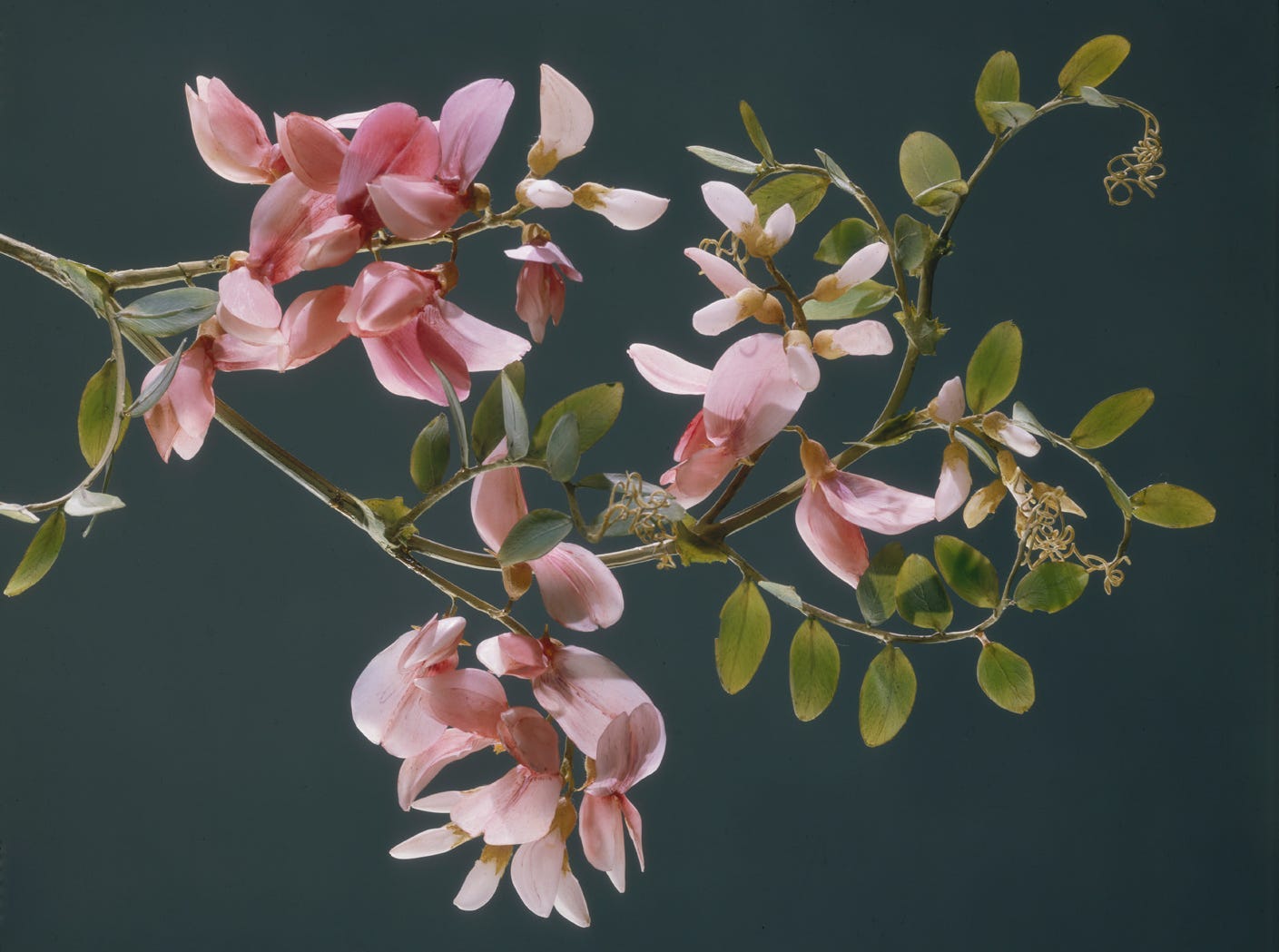
I was recently on a work trip to Boston, and I managed to check off a key item on every botany nerd’s bucket list: a visit to the Glass Flowers Gallery at the Harvard Museum of Natural History. The gallery features nearly 850 life-size anatomical models of plants, comprising more than 700 species from all around the world, each one made—inconceivably—from glass.
Designed as educational tools for the Botanical Museum at Harvard, the glass flowers are the work of Leopold and Rudolf Blaschka—a father and son team of Czech glass artists who developed the collection over a span of fifty years, from 1886 to 1936. I visited the collection on a Sunday afternoon, and the vibe in the room was one of pure incredulity. A steady chime of whoas and what?!s percolated through the gallery, punctuated by the occasional “no wayyy” and at least one “grandma’s ass it’s glass,” delivered in a thick Irish accent. The attention to detail was mesmerizing. Bewildering. Every little stamen was accounted for. Every tendril. Every vein. I could feel my brain begin to sputter and spark. At some point I just glitched out entirely. Mouth ajar, eyes asquint, the lines on my brow furrowing deeper and deeper.
Sprinkled throughout the models were thousands of microscopic enlargements—cross-sections of ovaries and reproductive tissues, scaled up to the size of coasters or fancy doilies. Elsewhere, delicate glass mosaics depicted the arrangement of cellular structures, a thousand times magnified, big as placemats. The oscillation in scale induced a kind of stereoscopic delirium—I was Alice at the tea party, completely unsure of what size I was meant to be. The reality I carried in with me began to flicker. I grew restless, agitated, delighted in my delirium. I had read the sign at the entrance, but I was no longer buying it. How could these not be real plants? And how the HELL were they made from glass?! My allegiance to logic evaporated. I was forced to admit: they were magic.
There is a particular uneasiness one feels when they are confronted with true magic. Not the sleight-of-hand, rabbit out of a hat, Vegas Strip, kid’s birthday party kind of magic—the kind that amuses and delights, leaving you chuckling and checking your ears for coins. No, I’m talking about real magic—the kind that splices the fabric of reality, that fractures your sense of truth and uproots your ability to perceive it. The kind that sows distrust between your head and your heart, that beckons you to abandon your footing, to suspend all disbelief. The kind of magic that makes you believe.
Michelangelo and his lot—they knew how to summon it. Puppeteers are skilled at it, too—infusing lifeless objects with a vitality that shakes the soul. I once met a pair of socks at St. Ann’s that made me cry in public.
I do try to keep my defenses up—to train my faculties to suss out the lies. The phishing scams, the doublespeak, the deep fakes and the impostors. I’m not so easily duped. I can tell when it’s AI.
Substackers consider the strangely chic crime heard round the world: the theft of France’s crown jewels.
Sloane Crosley: Every once in a while, a story comes along formed by a perfect synergy of comprehensible crime and real-time intrigue. These moments are like precious stones, and the internet goes berserk for them. One such tale began on Sunday, when robbers smashed a Seine-adjacent gallery window of the Louvre and made off with eight pieces of historically priceless jewelry.
Clara: Who needs yoga or deep breathing exercises when we have French heists of Napoleonic jewels to read about.
Maisa: Someone walked into the Louvre—in broad daylight—spent roughly the length of a rushed matcha run in a jewellery case, and walked out moments later with the French Crown Jewels.
Jo Piazza: France’s ministry of culture said the stolen items were:
A tiara and brooch belonging to Empress Eugénie, wife of Napoleon III
An emerald necklace and a pair of emerald earrings from Empress Marie Louise
A tiara, necklace and single earring from the sapphire set that belonged to Queen Marie-Amélie and Queen Hortense
A brooch known as the “reliquary brooch”
Maisa: They arrived in a lift, left on scooters, and—according to one witness—stopped at a red light on their way home. That’s not just audacity, that’s etiquette.
Clara: Considering the loneliness epidemic and the anti-intellectualism we find ourselves traversing as a society, it’s nice to see a group of friends get together and make museum plans for a Saturday morning. Gives a girl a bit of hope.
Jo Piazza: All of the stolen pieces are part of the national Crown Jewels collection, which means they aren’t privately insured (fascinating detail!). Recovery efforts began within hours, because once the jewelry is broken down into individual gems, they’re gonna be almost impossible to trace.
Clara: Like, I suspect, many other people, I guess I harbor a tiny bit of fascination with art heists—conceptually speaking, of course.
Sloane Crosley: It’s not that people are salivating at the idea of criminality, but some are agnostic about—nay, amused by—the robbery. Part of this is because fires aren’t funny and heists kind of are. They are painted as sexy, madcap or soulful in pop culture (“Ocean’s Eleven,” “The Thomas Crown Affair,” even “The Goldfinch”).
Maisa: A museum heist is so deliciously whimsical. It’s the cardigan of crimes, dashing, polite, borderline literary. Nobody’s grandma loses her pension, no innocent bystander is traumatized, and nothing explodes except the collective imagination. This is the sort of news story that reads like a short film: four shadowy figures, a perfect plan, and a little red-light courtesy on the getaway.
Jo Piazza: There were no smoke bombs or cinematic laser grids or someone dropping in from a ceiling. Just four people who understood museum security and knew their way around construction equipment and power tools.
Maisa: Of course this is satire, I’m not advocating for crime. But the romanticism of it, the elegance, the precision, that’s undeniably seductive. It’s proof that imagination still exists in a world allergic to surprise. In an era of scams and data leaks and faceless corruption, a good old-fashioned jewel heist feels almost wholesome.
PHOTOGRAPHY
HISTORY
Revolutionary media
Theo Lipsky on how the American Revolution was fueled not by scholarly treatises but by “amateurish, at times reductive pamphlets”—the viral content of their day.
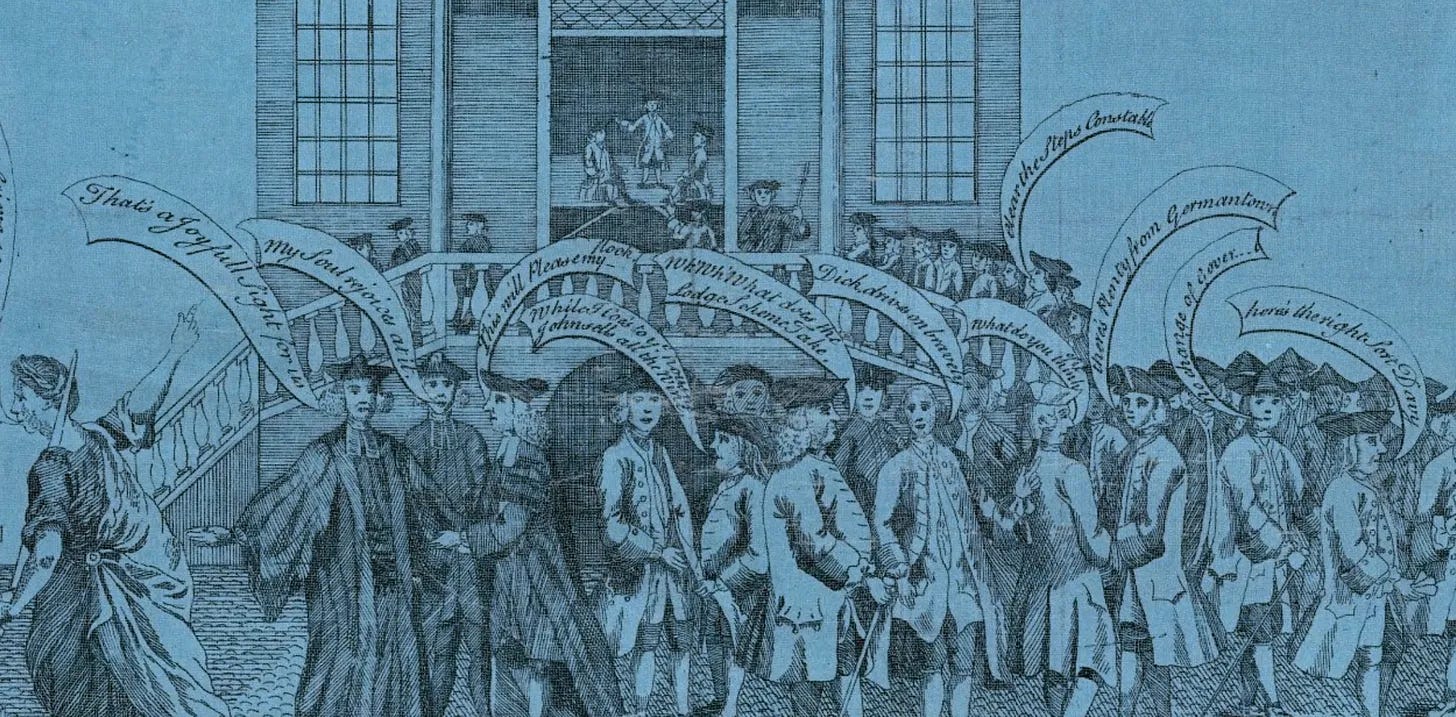
Bailyn’s point is that most of the revolutionaries were not inspired by what we today might call “deep reads.” Instead, the intellectual prime mover of the American Revolution was a corpus of amateurish, at times reductive pamphlets, given to disquiet and written for mass consumption. The Revolutionary-era pamphlets may now seem to have merely popularized or synthesized more important original thinkers, but Bailyn argues the extraordinary element at work was the rhetoric of the pamphlets themselves.
These pamphlets were in some ways familiar to us. They were accessible. They were grandiose. They came laden with cartoons. They were sarcastic. They were allegorical. They could spin out into long, acid exchanges and feuds between competing authors. And they peddled, for lack of a better term, conspiracy theories. Or so argues Bailyn:
The danger to America, it was believed, was in fact only the small, immediately visible part of the greater whole whose ultimate manifestation would be the destruction of the English constitution, with all the rights and privileges embedded in it. This belief transformed the meaning of the colonists’ struggle, and it added an inner accelerator to the movement of opposition. For, once assumed, it could not easily be dispelled: denial only confirmed it, since what the conspirators profess is not what they believe; the ostensible is not the real; and the real is deliberately malign.
None of this is to say that John Adams suffered the same strand of brainrot now apparently rampant thanks to the exquisitely designed user interfaces of most media platforms. It’s just to say that today’s readers are not alone in confronting a froth of fractious, charged, imprecise and conspiratorial stuff. Ironically, Bailyn says, the colonists read the authors of classical antiquity not to commune with antiquity on its own terms but because those authors, if narrowly understood, appeared to share the colonists’ concerns:
They had hated and feared the trends of their own time, and in their writing had contrasted the present with a better past, which they endowed with qualities absent from their own, corrupt era. The earlier age had been full of virtue: simplicity, patriotism, integrity, a love of justice and of liberty; the present was venal, cynical and oppressive.
It’s hard not to detect today a similar wistfulness about the past. One can take this either as dispiriting or reassuring—either things have always been that bad or things are better than they seem. The warm intelligence of Bailyn’s work is at least one reason to choose the latter.
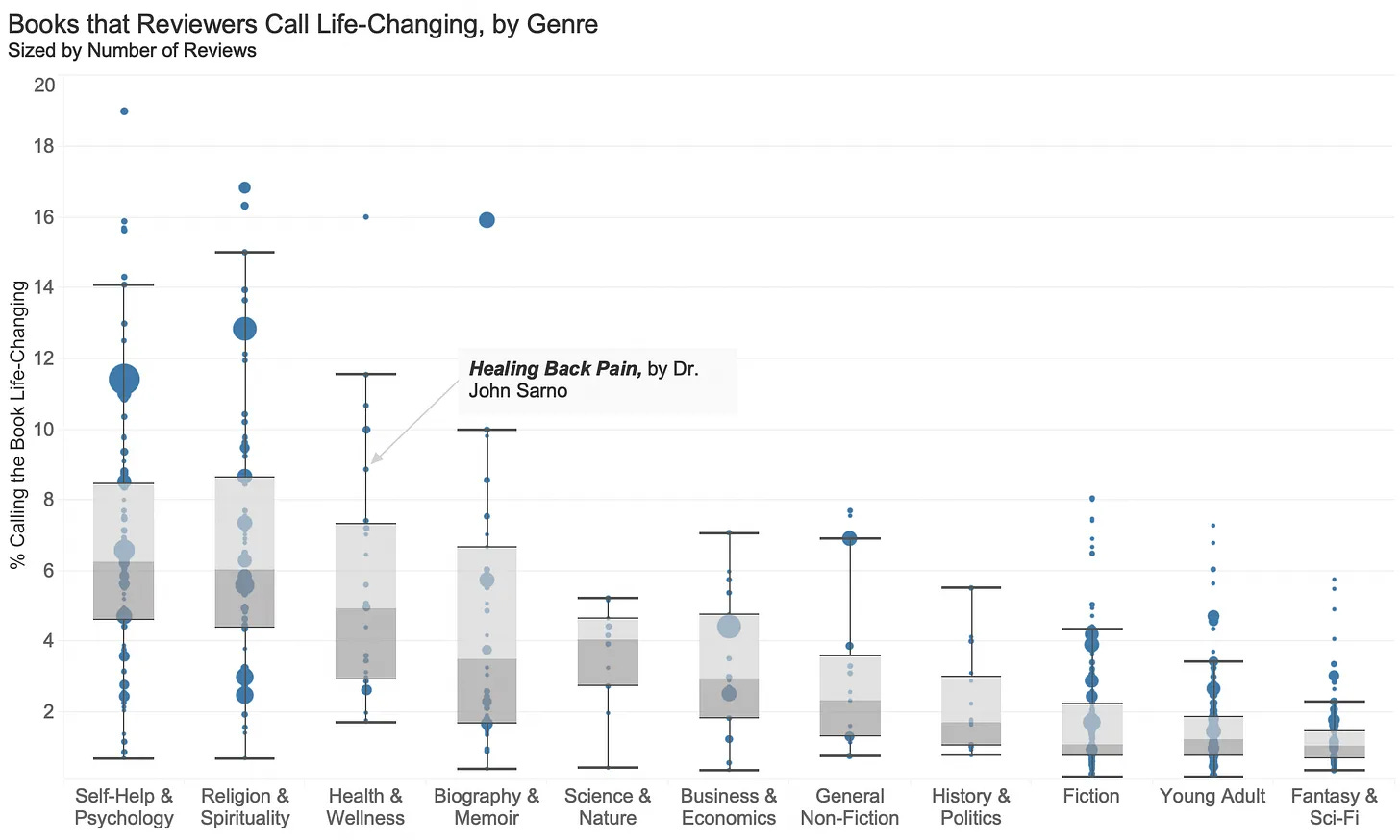
Joe Hovde analyzes thousands of book reviews to find which titles readers most often call “life-changing”—starting with one controversial volume that reportedly cures chronic back pain.
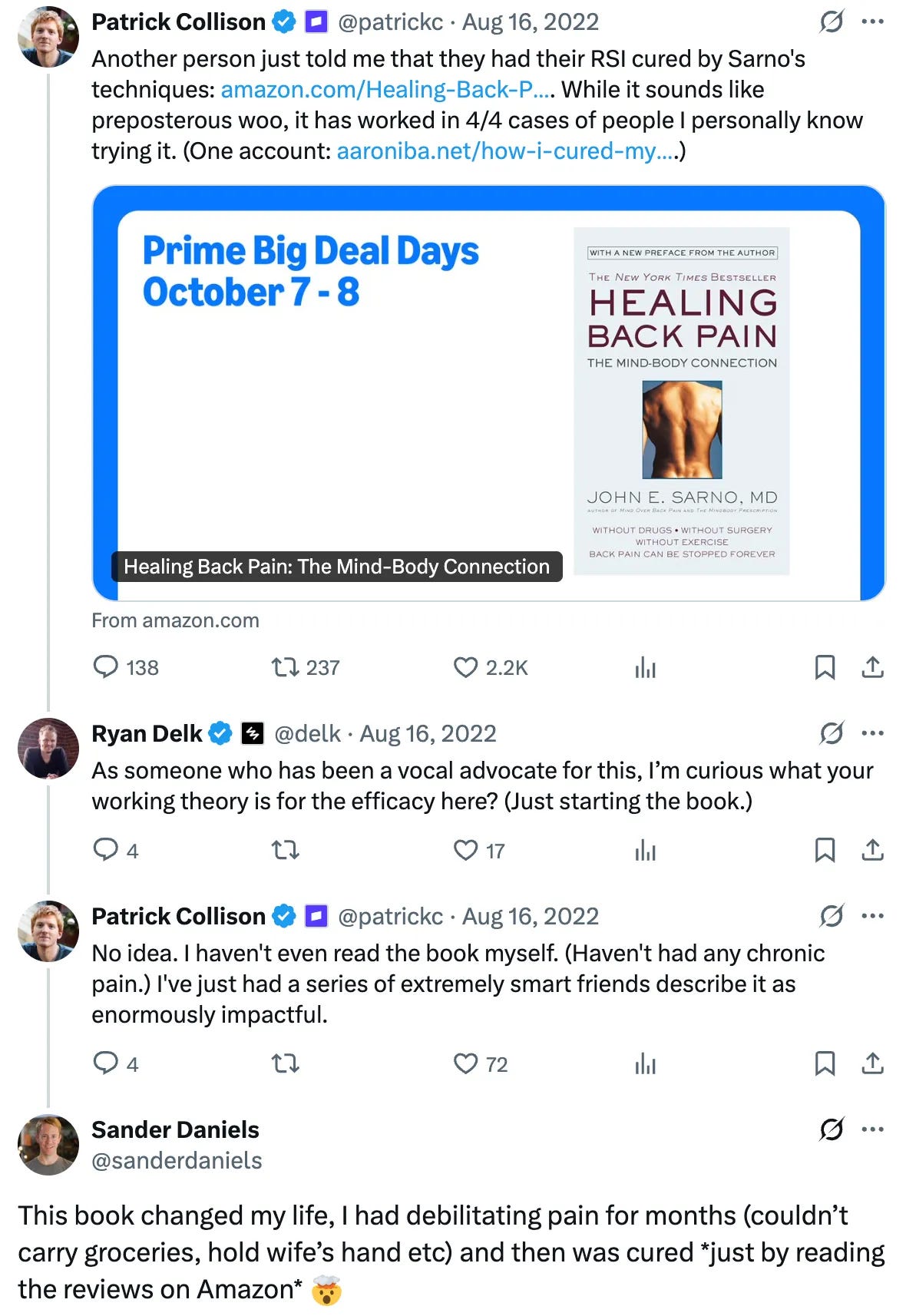
Three years ago, the CEO of Stripe tweeted about his friends curing their chronic back pain using Healing Back Pain, a controversial book from 1991. The book’s thesis is that a lot of physical pain is caused by repressed emotion, and that simply recognizing this connection can dramatically reduce the pain.
The co-founder of tech startup Thumbtack chimed in that his debilitating pain was cured just by reading the book’s reviews:
Can a book really do that? Can a book’s Amazon reviews really do that?
I don’t have much back pain these days, so I can’t personally test it (but if you do, please at least read its reviews and let me know).
It’s a seductive idea, that you can read a book and it will change the course of your life. I have found it to almost never be the case. Mostly my life bends with the ideas in the book I’m reading and then continues on its previous trajectory.
But it’s fun to explore books like these that had a profound impact on somebody. It feels like unmapped territory, a part of yourself waiting to be unlocked if you can find the key. So I found datasets of book reviews, from Amazon and Goodreads, and counted the reviews that call the book “life-changing” or similar. For example, here’s one such review of Healing Back Pain, which 6% of reviewers called life-changing:
The book that changed my life! This book is absolutely awesome. I have an extensive ballet background along with aerobics and general fitness practices. I have chronic low back pain which gets debilitating at times . . . until this book.
As you might expect, this analysis leads us deep into the self-help aisle. A lot of these books seem kind of ridiculous; they make fabulous claims and it’s hard to trust that your experience of the book would line up with the people in the reviews. That is why firsthand accounts by people who are credible in some way are so powerful; Collison being a billionaire fintech CEO means he presumably isn’t sharing Healing Back Pain for the affiliate fees.
Actress and Beau Society founder Hailee Steinfeld has joined Substack, where she’ll post life updates, unscripted conversations, behind the scenes from film sets, and more.
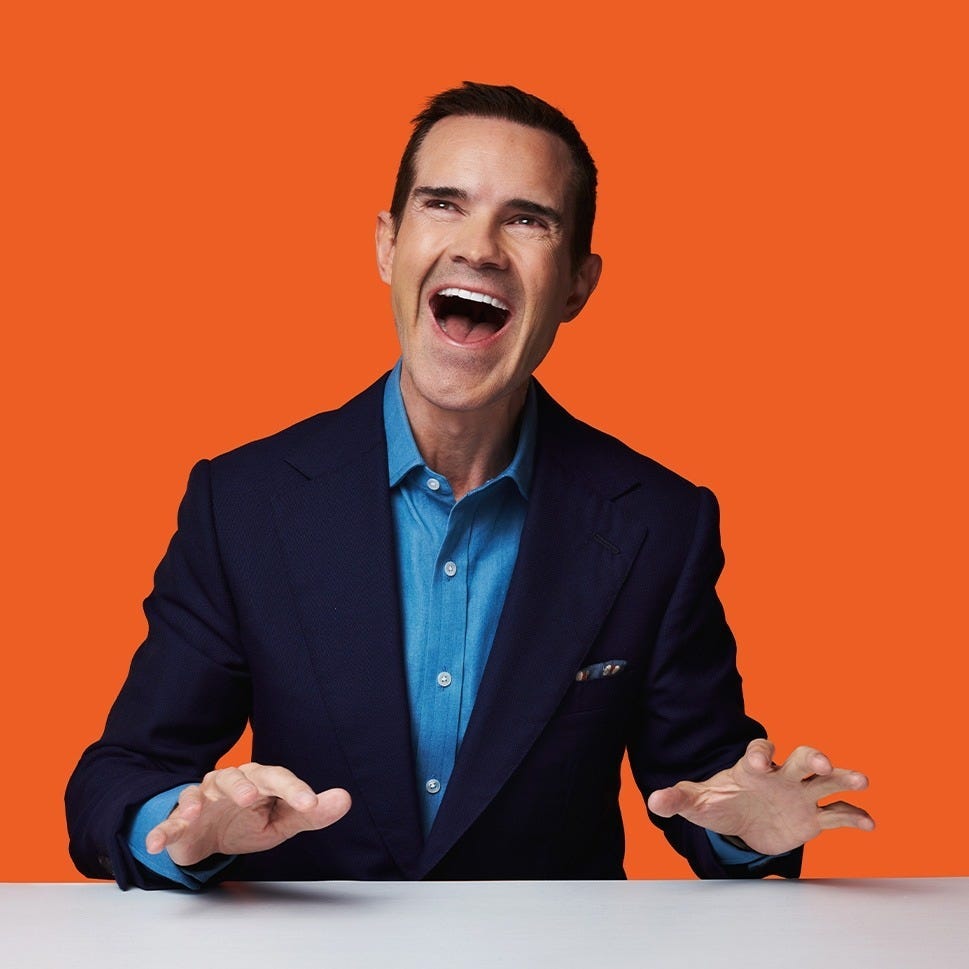
On Substack, the standup comedian and author Jimmy Carr will offer “the backstage pass to my brain: fewer punchlines, more what controls the strings.”
Chris Philp MP, the Shadow Home Secretary and Member of Parliament for Croydon South, has joined Substack, where he’s sharing his perspective on British politics.
Inspired by the writers and creators featured in the Weekender? Starting your own Substack is just a few clicks away:
The Weekender is a weekly roundup of writing, ideas, art, audio, and video from the world of Substack. Posts are recommended by staff and readers, and curated and edited by Alex Posey out of Substack’s headquarters in San Francisco.
Got a Substack post to recommend? Tell us about it in the comments.
The jewel heist makes us ask what we value — and why. What gives meaning to things? It’s such a fascinating cultural event. In the shadow of the U.S. government shutdown, it also reminds us to seek meaning elsewhere, beyond the archaic past we cling to.















The jewel heist makes us ask what we value — and why. What gives meaning to things? It’s such a fascinating cultural event. In the shadow of the U.S. government shutdown, it also reminds us to seek meaning elsewhere, beyond the archaic past we cling to.
Love the title! Made me chuckle